




Understanding the Stacker-Reclaimer in Bulk Material Handling
The Stacker-Reclaimer is among core core-based machinery involved in bulk material handling of today’s operations. In the stockyards and storage terminals, it executes two main functions by which it stacks the bulk materials into organized piles within a specified area and reclaims them from storage to be further processed or transported. This makes labor work very convenient, hence operational efficiency is realized. The stacker-reclaimer has become an indispensable machine for mining companies as well as coal power plants plus cement factories, steel mills at ports engaged in logistics, besides chemical industries.
Since the worldwide demand for raw materials remains high, efficient management at stockyards becomes all the more critical. Continuously supporting material flow and minimizing operational downtime and environmental aspects through effective storage-retrieval operations, a stacker reclaimer is hence considered to be one of the best solutions in such applications. Long life, reliability with different consumables, and parameters of operation; these constitute its basic engineering design features.
Engineering Principles Behind the Stacker-Reclaimer
Structural Framework and Mechanical Design
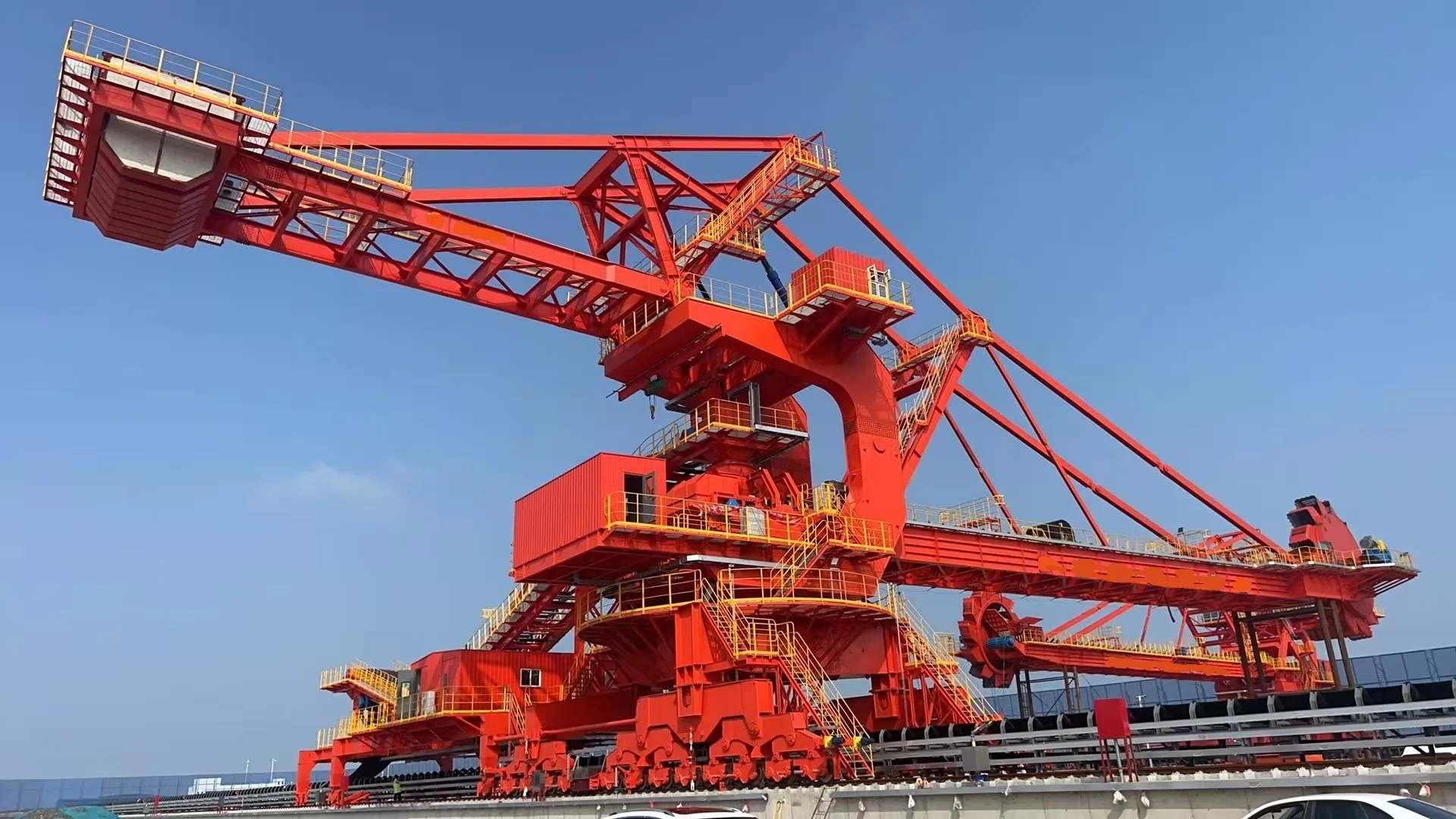
A stacker-reclaimer includes a heavy structural frame capable of supporting long conveyor systems, rotary booms, and various mechanical components. The usual construction consists of a carriage or traveling base and boom structure with a counterweight system, together with a reclaiming bucket wheel or scraper mechanism plus a conveyor for carrying the material.
The machine structure is engineered for stability over a long span across the stockyard or on any uneven ground surface. Being a giant machine, the structure of the stacker-reclaimer has to be designed within high parameters of safety against loads and vibrations.
Integrated Conveyor and Boom System
The conveyor system forms the heart of the stacking operation. It carries bulk material from an upstream process-such as ship unloading, material crushing, or transportation belts-toward the stockpile area. The boom, which supports the discharge end of the conveyor, either rotates or luffs to spread material uniformly in the stockyard. The boom may be capable of a full 360-degree rotation or may travel through only a fixed arc, depending upon design.
Stacking methods help achieve optimum homogenization-cheap storage space, and utilization of the stockyard. Chevron stacking, windrow stacking, or even simple cone-shell stacking can be practiced depending upon the nature of the material and the convenience in stockyard management.
Reclaiming Mechanisms
The reclaiming function may be performed by bucket wheels, scrapers, or a combination of both. In bucket wheel reclaimers, rotating buckets pick up the material and dump it onto a reclaiming conveyor. In scraper reclaimers, continuously scraping blades carry the material toward conveyor systems.
Downstream processes are a general term describing any of the following procedures: coal furnace, ore processing plant, clinker cooler, or ship loading conveyor. All of these require that reclaimed material be provided to them in steady flows, irrespective of the reclaiming method.
Advantages of Using a Stacker-Reclaimer in Industrial Operations
High Efficiency in Bulk Material Management
The stacker-reclaimer automates stockyard operations, significantly increasing material handling speed. It enables continuous stacking and reclaiming processes without interruptions, improving throughput and reducing equipment idling time.
Reduced Labor Costs and Operation Time
Automated control systems allow the stacker-reclaimer to operate with minimal human supervision. This reduces workforce requirements while improving accuracy and safety. Operators can control the machine from remote stations or through integrated monitoring systems.
Improved Material Homogenization
Effective homogenization improves product quality in industries such as cement production and mineral processing. By using programmed stacking patterns, a stacker-reclaimer reduces material variability and creates uniform product characteristics during downstream processing.
Long-Term Durability
Stacker-reclaimers are engineered for continuous operation in harsh environments. Their corrosion-resistant components, robust machinery, and dust-resistant designs ensure long service life even in extreme weather or under abrasive material conditions.
Reduced Environmental Impact
Efficient stacking and reclaiming minimize dust emissions, reduce material spillage, and support environmentally responsible stockyard management. Modern machines also include enclosed conveyors, dust suppression systems, and energy-efficient motors.
Types of Stacker-Reclaimers
Bucket Wheel Stacker-Reclaimer
This is the most widely used design for large stockyards. It features a bucket wheel that scoops material and transports it onto conveyors. It is suitable for large-volume operations involving coal, iron ore, bauxite, or limestone.
Scraper Stacker-Reclaimer
Equipped with scraper blades, this type is ideal for sticky, fine, or low-density materials. It is often used in cement plants, biomass facilities, fertilizer warehouses, and gypsum storage areas.
Combined or Circular Stacker-Reclaimer
Circular systems maximize space efficiency by stacking materials in 360-degree circular stockyards. They are used in locations where land space is limited, such as ports and compact industrial facilities.
Bridge-Type Stacker-Reclaimer
This design offers superior homogenization due to its wide reclaiming bridge and continuous scraping action. It is commonly used in the cement and mining industries where uniform material blending is essential.
Key Components and Their Functions
Traveling Base System
The machine moves along rails across the stockyard. The traveling system includes drive motors, wheel bogies, and traction mechanisms that ensure smooth and stable movement.
Boom and Counterweight
The boom distributes materials while the counterweight balances the system to maintain stability. Some designs include luffing mechanisms that allow vertical boom adjustments for optimized stacking.
Conveyor System
Conveyors deliver materials into and out of the stockpile. Their width, speed, and drive power depend on material type and desired throughput capacity.
Bucket Wheel or Scraper Mechanism
These components perform the reclaiming function. Bucket wheels rotate to scoop and discharge materials, while scraper blades drag the material toward the transfer point.
Automation and Control Systems
Modern stacker-reclaimers integrate sensors, PLC automation, remote monitoring, positioning systems, and safety interlocks. These systems enhance accuracy, reduce downtime, and improve operational safety.
Operation Methods of a Stacker-Reclaimer
Stacking Operation
During stacking, the machine receives bulk material from upstream conveyors and deposits it into the designated area. Automation systems control the boom position, conveyor speed, and movement pattern to ensure uniform stacking.
Reclaiming Operation
In reclaiming mode, the bucket wheel or scraper removes material from the stockpile and transfers it to downstream conveyors. The machine moves steadily along the stockyard to reclaim material efficiently and uniformly.
Transition Between Modes
One of the defining features of a stacker-reclaimer is its ability to switch between stacking and reclaiming modes according to operational requirements. This flexibility supports continuous production schedules.
Industries That Rely on Stacker-Reclaimers
Mining and Mineral Processing
Mining sites rely on stacker-reclaimers to store and manage ore, bauxite, copper concentrate, and other minerals. Efficient stockyard operations support uninterrupted processing and transportation.
Coal Power Plants
Coal-fired power facilities use stacker-reclaimers to maintain a stable coal supply for boilers. Material homogenization ensures steady fuel quality and combustion efficiency.
Steel and Metallurgy
Iron ore, coke, limestone, and other raw materials used in steelmaking require organized storage and predictable material flow. Stacker-reclaimers improve material consistency and reduce production delays.
Cement Production
Cement plants benefit from improved material uniformity when feeding limestone, clay, iron ore, and coal into kilns. This increases clinker quality and energy efficiency.
Ports and Logistics
Bulk cargo terminals use stacker-reclaimers for temporary storage of grains, fertilizers, minerals, and biomass. They support efficient unloading and loading operations for ships and trucks.
How to Choose the Right Stacker-Reclaimer
Capacity Requirements
Stockyard size, material volume, and operational frequency determine the machine’s required capacity. Large industrial operations benefit from high-capacity bucket wheel designs, while smaller facilities may prefer scraper or circular types.
Material Characteristics
Particle size, density, abrasiveness, and moisture content affect machine selection. Hard and abrasive materials require stronger bucket wheels, while sticky materials perform better with scraper reclaimers.
Environmental and Space Considerations
Harsh weather conditions, limited ground space, and environmental regulations influence design choices. Circular stockyards deliver high storage capacity in small areas.
Automation Needs
Advanced automation improves efficiency and reduces labor. Facilities with 24/7 operations often use fully automated stacker-reclaimers with programmable positioning systems.
Maintenance Requirements for Stacker-Reclaimers
Regular Mechanical Inspection
Components such as bearings, motors, gearboxes, and conveyor rollers require periodic inspection to ensure long-term performance.
Lubrication and Cleaning
Lubricating moving parts and cleaning material buildup reduces wear and prevents downtime.
Monitoring Wear and Replacement
Bucket wheel teeth, scraper blades, and conveyor belts gradually wear and must be replaced to maintain performance.
Electrical and Automation System Checks
Sensors, wiring, circuits, and control panels must be checked to ensure accurate operation and prevent unexpected failure.
Market Trends and Technological Development
Increased Automation Integration
Modern stacker-reclaimers incorporate AI-assisted control, real-time monitoring, and automated diagnostics. These technologies reduce human error and improve stockyard efficiency.
Energy-Efficient Design
Manufacturers increasingly adopt energy-saving motors, optimized conveyor systems, and regenerative power technology to reduce overall power consumption.
Emphasis on Environmental Protection
Dust suppression, noise reduction, and enclosed conveyor systems improve environmental performance and comply with global sustainability standards.
Growing Demand in Developing Economies
Rapid industrialization in Asia, South America, and Africa increases the demand for large-scale bulk handling solutions, boosting the market for stacker-reclaimers.
Conclusion
The Stacker-Reclaimer is an important machine of today’s bulk material handling. The operation helps support industries by working efficiently in storage, homogenizing, or reclaiming operations. It has strong engineering features with automated controls and flexible design configurations that deliver the maximum efficiency mining companies seek, power generation firms desire; port logistics require steel producers yearn for cement manufacturers covet! As industrial standards change to higher levels, while more materials are needed worldwide, the stacker-reclaimer will be very useful in increasing productivity, using up less stockyard space, meanwhile keeping a steady flow of materials through difficult industrial environments.