




Abstract
Single-girder beam launchers represent a specialized category of bridge construction equipment designed to efficiently install precast concrete beams in segmental bridge projects. This article explores the operational principles, technical specifications, and engineering advantages of single-girder beam launchers in contemporary infrastructure development. Targeting civil engineers, project managers, and procurement specialists, the content provides comprehensive insights into beam launching technology, equipment selection criteria, and construction methodology optimization. Understanding how single-girder beam launchers outperform traditional crane-based methods is essential for modern bridge construction.
Fundamental Operating Principles of Single-Girder Beam Launchers
Structural Configuration and Load Transfer Mechanism
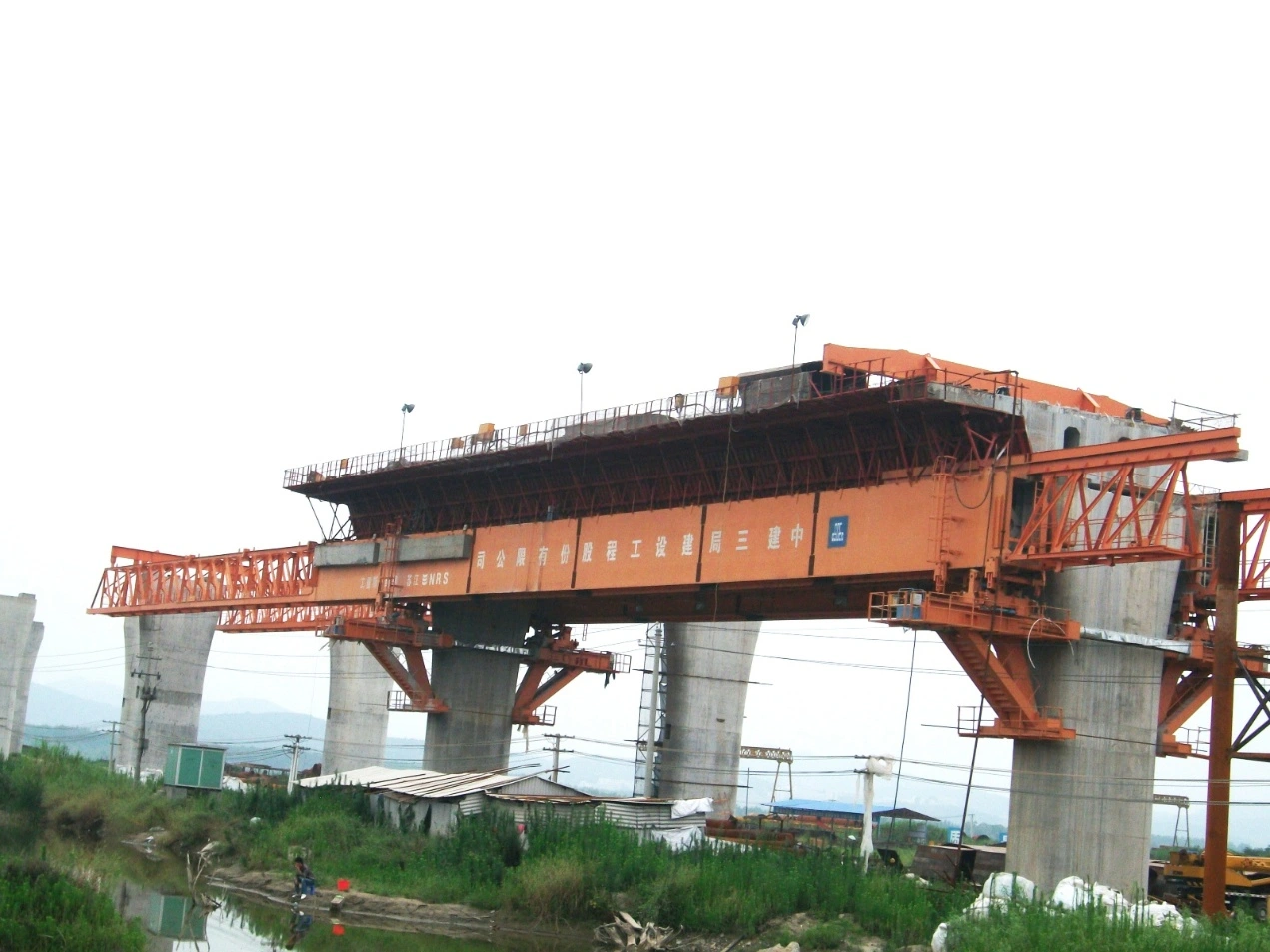
Single-girder beam launchers utilize a cantilever support system as their primary structural framework. The main longitudinal girder, typically fabricated from high-strength structural steel (Grade S355 or ASTM A572), extends beyond the installed bridge deck to receive incoming precast beams. This cantilever configuration distributes loads through a triangulated truss design, transferring vertical forces to pier caps via support legs equipped with spherical bearings. The unique design of single-girder beam launchers allows them to operate with minimal ground disturbance.
The load transfer mechanism operates through a dual-path system. Primary loads transmit directly through the main girder to front and rear support points, while secondary stabilization comes from lateral bracing members that resist torsional forces during beam placement. Hydraulic lifting mechanisms positioned at strategic intervals along the girder provide vertical adjustment capabilities, enabling precise elevation control during beam installation. These hydraulic cylinders operate in synchronized pairs, with pressure sensors ensuring uniform load distribution across all lifting points. Such precision is a hallmark of well-engineered single-girder beam launchers.
Longitudinal travel rails mounted on previously installed bridge segments enable the launcher’s self-propelling capability. The rail system typically consists of hardened steel tracks (Brinell hardness 300-350 HB) that interface with motorized bogies. Each bogie incorporates redundant drive systems with individual load cells monitoring weight distribution in real-time. The travel mechanism allows the launcher to advance incrementally after each beam installation, repositioning for the next construction cycle without requiring external crane assistance. This self-mobility distinguishes single-girder beam launchers from many alternative methods.
Beam Positioning and Installation Sequence
The beam launching cycle follows a precise six-phase operational sequence. Phase one initiates with the launcher positioned over the target installation location, with rear support legs anchored to the completed bridge deck and front support legs resting on the upcoming pier. Vehicles deliver precast beams to the launcher’s rear loading zone, where overhead gantry systems lift the beam onto the main girder’s support cradle. This workflow is optimized specifically for single-girder beam launchers.
Phase two involves longitudinal beam transport along the launcher’s deck. Motorized trolleys equipped with polyurethane-coated rollers move the beam forward at controlled speeds (typically 2-5 meters per minute) to prevent dynamic loading. Laser alignment systems continuously monitor beam position relative to the launcher’s centerline, with automated corrections maintaining lateral positioning within ±3mm tolerance. The accuracy achieved by modern single-girder beam launchers is unmatched in bridge construction.
During phase three, hydraulic lifting cylinders lower the beam toward its final position while maintaining precise horizontal alignment. Operators utilize dual-axis inclinometers to verify beam slope matches design specifications (typically ±0.1° tolerance). Temporary support brackets engage with embedded lifting inserts in the beam, allowing controlled descent rates of 10-15mm per second. Single-girder beam launchers excel at this delicate lowering phase.
Phase four establishes temporary support connections between the beam and pier bearings. Adjustable steel wedges or hydraulic jacks fine-tune beam elevation to match surveyed benchmarks, compensating for thermal expansion, concrete creep, and construction tolerances. Once alignment verification confirms compliance with design parameters, grouting operations secure the beam to permanent bearing pads. The versatility of single-girder beam launchers accommodates various bearing configurations.
Phase five releases the launcher’s lifting mechanisms, transferring full load to the bridge’s permanent support system. Load cells verify complete disengagement before phase six initiates launcher advancement. The entire equipment assembly travels forward one span length, repositioning for the next installation cycle. Typical cycle times range from 4-8 hours per beam, depending on span length and site logistics. Contractors who deploy single-girder beam launchers consistently report faster cycle times than crane-based alternatives.
Technical Specifications and Performance Parameters
Load Capacity and Span Range
Modern single-girder beam launchers offer load capacities ranging from 50 to 200 metric tons, accommodating diverse bridge design requirements. Standard configurations include 80-ton models for urban viaduct applications, 120-ton systems for highway overpasses, and heavy-duty 180-200 ton variants for railway infrastructure projects. The structural capacity directly correlates with main girder dimensions—typical cross-sections measure 1.8-2.5 meters in height with flange widths of 800-1200mm. Selecting the right capacity among single-girder beam launchers is critical for project success.
Operational span ranges vary based on launcher configuration and beam weight. Lightweight 50-ton systems effectively handle spans of 20-30 meters, while mid-range 100-ton models accommodate 25-40 meter spans. Heavy-duty configurations extend operational capability to 45-50 meter spans, though economic optimization typically occurs in the 30-40 meter range where equipment utilization balances against crane-based alternatives. Single-girder beam launchers are most cost-effective in repetitive-span projects.
Structural steel selection significantly impacts performance parameters. Primary load-bearing members utilize Grade S355J2 steel (yield strength 355 MPa) in European specifications or ASTM A572 Grade 50 (yield strength 345 MPa) in North American applications. Critical connection points incorporate higher-grade S460 steel for fatigue resistance in cyclic loading scenarios. All structural components undergo ultrasonic testing to verify weld integrity and material homogeneity. Manufacturers of single-girder beam launchers must adhere to strict material certifications.
Hydraulic System and Control Precision
The hydraulic power system operates at working pressures between 200 and 280 bar (2900-4060 psi), providing sufficient force for precise beam positioning while maintaining component longevity. High-pressure pumps deliver flow rates of 80-150 liters per minute, enabling lifting speeds that balance productivity with safety requirements. Proportional control valves modulate flow to individual cylinders, allowing independent adjustment of each lifting point. The hydraulic architecture of single-girder beam launchers enables smooth, jerk-free beam handling.
Positioning accuracy represents a critical performance parameter in beam launcher specifications. Contemporary systems achieve vertical positioning precision of ±5mm across the entire beam length, with lateral alignment maintained within ±3mm tolerances. This accuracy derives from integrated sensor networks combining laser distance measurement, digital inclinometers, and hydraulic pressure transducers. Control systems process sensor data at 50Hz sampling rates, implementing real-time corrections through closed-loop feedback algorithms. Single-girder beam launchers equipped with such sensors reduce rework and alignment errors.
Automated control options increasingly replace manual operation in modern beam launchers. Programmable logic controllers (PLCs) execute predefined installation sequences, managing hydraulic valve timing, travel motor coordination, and safety interlock verification. Human-machine interfaces (HMIs) provide operators with graphical representations of system status, load distribution, and positional data. Advanced systems incorporate GPS-based positioning for absolute coordinate verification, enabling ±10mm accuracy relative to global reference frames. The trend toward automation makes single-girder beam launchers even more attractive for large-scale projects.
Comparative Specifications Table
| Configuration | Load Capacity | Max Span | Hydraulic Pressure | Positioning Accuracy | Power Requirements |
|---|---|---|---|---|---|
| Light-Duty | 50-80 tons | 20-30m | 200-220 bar | ±5mm vertical | 45-60 kW |
| Standard | 100-120 tons | 30-40m | 220-250 bar | ±5mm vertical, ±3mm lateral | 75-90 kW |
| Heavy-Duty | 150-200 tons | 40-50m | 250-280 bar | ±3mm vertical, ±2mm lateral | 110-150 kW |
Compliance Standards and Safety Requirements
International Design and Manufacturing Standards
Single-girder beam launchers design adheres to EN 13001 (Crane Safety – General Design), which establishes calculation principles for steel structures, mechanisms, and load-bearing components. Part 2 of this standard specifically addresses load actions and load combinations relevant to bridge construction equipment, defining load factors for operational, test, and exceptional loading scenarios. Manufacturers must demonstrate compliance through detailed structural calculations verified by third-party certification bodies. Any supplier of single-girder beam launchers should provide EN 13001 documentation.
ISO 9927 (Inspection of Hoisting Equipment) provides inspection protocols and acceptance criteria applicable to beam launcher hydraulic systems and lifting mechanisms. This standard mandates non-destructive testing intervals, load testing procedures, and documentation requirements for equipment certification. Compliance verification includes magnetic particle inspection of welded joints, ultrasonic examination of structural members, and hydraulic pressure testing at 1.25 times maximum working pressure. Single-girder beam launchers meeting ISO 9927 ensure reliable field performance.
AASHTO LRFD Bridge Design Specifications influence beam launcher design parameters through defining load factors and resistance factors for temporary construction equipment. While primarily a bridge design code, Section 5 (Concrete Structures) establishes handling stress limits for precast beams that directly impact launcher lifting point locations and support configurations. Equipment specifications must demonstrate compatibility with beam reinforcement layouts and embedded hardware positioning. Single-girder beam launchers designed with AASHTO in mind integrate seamlessly into North American projects.
Operational Safety Protocols
Pre-operational load testing constitutes a mandatory safety requirement for beam launcher deployment. Initial commissioning tests apply 125% of rated capacity with the equipment in its most unfavorable configuration—maximum cantilever extension with eccentric loading. Test protocols measure deflection at critical points, verify hydraulic system performance under sustained load, and confirm structural integrity through strain gauge monitoring. Annual recertification tests apply 110% rated load to verify continued compliance. Single-girder beam launchers with proper certification reduce liability and insurance costs.
Wind speed restrictions prevent operation when environmental conditions exceed equipment design parameters. Standard limitations prohibit beam handling when sustained wind speeds exceed 10 m/s (36 km/h) or gust speeds surpass 15 m/s (54 km/h). Anemometers mounted on the launcher’s highest point provide continuous wind monitoring, with automatic interlocks halting operations when thresholds are exceeded. Temperature considerations restrict operations outside -10°C to +40°C ranges to prevent hydraulic fluid viscosity issues and thermal expansion complications. Operators of single-girder beam launchers must be trained on these environmental limits.
Emergency braking systems incorporate redundant safety features across all motion axes. Longitudinal travel mechanisms include spring-applied, hydraulically-released brake calipers on each bogie, providing fail-safe stopping capability independent of hydraulic pressure. Vertical lifting systems utilize hydraulic lock valves that automatically engage upon pressure loss, preventing uncontrolled beam descent. Manual override controls enable emergency lowering at reduced speeds (maximum 5mm/second) if primary systems fail. These safety redundancies make single-girder beam launchers inherently safer than crane-based methods in congested work zones.
Application Scenarios and Commercial Value
Optimal Project Types for Single-Girder Systems
Urban viaduct construction represents the primary application domain for single-girder beam launchers. These elevated roadway systems typically feature 25-35 meter span lengths with repetitive pier spacing, creating ideal conditions for launcher efficiency. Limited ground-level access in urban environments restricts conventional crane operations, while beam launchers operate entirely from the elevated structure, eliminating ground support requirements. Projects involving 15+ consecutive spans achieve optimal equipment utilization, amortizing mobilization costs across multiple installation cycles. Single-girder beam launchers are particularly valuable in dense city centers.
Highway overpass construction benefits from beam launcher technology when site constraints limit crane positioning. Installations above active traffic corridors require minimal ground disruption, as launchers advance along completed bridge sections without occupying roadway space. The self-contained nature of launcher operations reduces traffic management costs and accelerates project timelines compared to methods requiring lane closures for crane outrigger placement. Single-girder beam launchers have become standard equipment for highway interchange upgrades.
Railway bridge applications increasingly specify single-girder beam launchers for installations above operational rail corridors. The equipment’s ability to work within restricted possession windows (typically 4-6-hour overnight periods) aligns with railway infrastructure maintenance schedules. Precise positioning capabilities ensure compliance with strict railway clearance envelopes, while the controlled installation process minimizes vibration transmission to active tracks. Railway authorities often mandate single-girder beam launchers for electrified lines where crane booms pose contact wire risks.
Cost-Benefit Analysis in Bridge Construction
Labor reduction constitutes a primary economic advantage of beam launcher deployment. Traditional crane-based beam installation requires 12-15 personnel per operation—crane operators, riggers, surveyors, and support crews. Single-girder beam launchers’ operations reduce crew requirements to 6-8 personnel, achieving 30-40% labor cost savings per beam installation. Over projects involving 50+ beams, cumulative labor savings often exceed $200,000-$300,000. These savings alone can justify investing in single-girder beam launchers.
Construction cycle acceleration delivers significant schedule compression benefits. Conventional crane methods average 1.5-2 beams per day under optimal conditions, while single-girder beam launchers consistently achieve 2-3 beam installations daily. On a 60-beam project, this productivity increase compresses schedules by 15-25 working days, reducing indirect costs (site overhead, supervision, traffic management) by $150,000-$250,000. Earlier project completion generates revenue acceleration benefits for toll facilities and reduces public inconvenience costs. Contractors using single-girder beam launchers gain competitive bidding advantages.
Equipment return on investment timelines vary based on project scale and regional labor rates. Purchase costs for standard 100-120 ton single-girder beam launchers range from $1.2-$2.5 million, while rental rates average $35,000-$55,000 monthly. Contractors executing 2-3 major bridge projects annually typically achieve ROI within 24-36 months through combined labor savings, schedule acceleration, and equipment redeployment across multiple sites. Regional markets with high labor costs (Western Europe, North America, Australia) demonstrate faster payback periods than emerging markets with lower wage structures. Fleet owners of single-girder beam launchers report high utilization rates.
FAQ
Q1: What is the typical construction speed advantage of single-girder beam launchers compared to crane-based methods?
Single-girder beam launchers typically install 2-3 precast beams per 8-hour shift under normal operating conditions, compared to 1-1.5 beams daily using mobile crane methods. This 40-60% productivity increase derives from eliminated crane repositioning time, reduced rigging complexity, and streamlined beam delivery logistics. The cumulative effect on project duration becomes significant in multi-span bridges—a 40-span viaduct completed in 15-20 working days with a launcher versus 25-35 days using conventional methods. Weather sensitivity also favors launchers, as their enclosed working platform enables operations during light precipitation that would halt crane activities.
Q2: How do environmental factors (wind, temperature) affect beam launcher operations?
Wind represents the primary environmental constraint, with operations restricted when sustained speeds exceed 10 m/s or gusts surpass 15 m/s. These thresholds prevent aerodynamic loading on suspended beams that could induce lateral oscillations or compromise positioning accuracy. Temperature extremes affect hydraulic fluid viscosity—below -10°C, oil thickening reduces system responsiveness, while above +40°C, decreased viscosity may cause internal leakage in cylinders and valves. Thermal expansion considerations require morning/afternoon survey verification, as a 20°C temperature change induces 2-3mm dimensional variation in a 30-meter steel launcher structure. Operators of single-girder beam launchers compensate through real-time adjustment of positioning references based on ambient temperature monitoring.
Q3: What are the maintenance intervals and critical inspection points for hydraulic components?
Hydraulic system maintenance follows manufacturer-specified intervals, typically requiring daily visual inspections, weekly fluid level verification, and monthly filter replacement during active deployment. Critical inspection points include cylinder rod surfaces (checking for scoring or corrosion), hydraulic hose assemblies (examining for abrasion or deterioration), and proportional valve connectors (verifying electrical contact integrity). Annual maintenance involves complete hydraulic fluid replacement (typically ISO VG 46 anti-wear hydraulic oil), pressure relief valve calibration testing, and cylinder seal replacement. Accumulator pre-charge pressure requires quarterly verification to maintain emergency function capability. Detailed maintenance logs documenting all inspections, fluid analyses, and component replacements are mandatory for certification compliance and warranty validity. Owners of single-girder beam launchers should implement a computerized maintenance management system.
Q4: Can single-girder beam launchers be used on curved or skewed bridges?
Yes, many modern single-girder beam launchers are designed to accommodate curved and skewed bridge alignments. Rotational adapters on support legs allow the launcher to pivot up to ±15° from the bridge centerline. Specialized trolley systems with independent steering enable longitudinal travel along curved deck profiles. For highly curved spans (radius less than 300 meters), some contractors use articulated launcher segments or secondary guidance rails. However, curved installations require extended setup time and may reduce the maximum beam weight capacity by 15-20% due to increased torsional loads. Always consult the launcher manufacturer’s curvature envelope before bidding curved bridge projects with single-girder beam launchers.
Q5: What is the typical rental vs. purchase decision criteria for beam launchers?
Renting single-girder beam launchers is recommended for contractors with fewer than 300 beam installations annually or for one-off bridge projects. Rental agreements typically include delivery, assembly supervision, and technical support, reducing upfront capital exposure. Purchasing is economically justified when annual utilization exceeds 500 beams or when the contractor has multiple concurrent bridge projects that can share the equipment. Owned launchers also provide depreciation benefits and customization options. A hybrid approach—renting for the first project to validate requirements, then purchasing for subsequent projects—is common among mid-sized civil contractors. For large infrastructure firms, owning a fleet of single-girder beam launchers becomes a strategic asset.
Conclusion
Single-girder beam launchers optimize modern bridge construction through precise load handling, automated positioning systems, and compliance with international safety standards. The technology delivers measurable advantages in labor efficiency (30-50% reduction), construction velocity (40-60% faster installation rates), and operational safety compared to conventional crane-based methods. Proper equipment selection based on project-specific parameters—span length, beam weight, site constraints—directly impacts construction efficiency and total project costs.
Understanding operational principles enables informed procurement decisions, while awareness of technical specifications ensures compatibility with project requirements. The integration of advanced hydraulic control systems, structural optimization, and comprehensive safety protocols positions single-girder beam launchers as essential equipment for infrastructure development stakeholders pursuing accelerated delivery timelines and enhanced construction quality in segmental bridge projects.
Ready to upgrade your bridge construction capabilities? Feel free to contact us anytime.