



Abstract
In today’s infrastructure projects, limited lateral space has become one of the biggest challenges for bridge contractors. Urban viaducts, mountain highways, and railway crossings often leave little room for traditional construction equipment. Single girder beam launchers provide an efficient and practical solution, delivering a 40-50% reduction in working width compared to conventional dual-girder systems while maintaining strong structural performance and operational safety.
This article offers a comprehensive analysis of single girder beam launchers, comparing them directly with dual-girder configurations across technical design, load capacity, site adaptability, and overall project economics. Whether you are facing tight urban corridors, strict clearance requirements, or challenging terrain, this guide will help you understand when and why a single girder system can deliver significant advantages in cost, speed, and feasibility.
Technical Architecture and Load Distribution Principles
Structural Configuration of Single Girder Systems
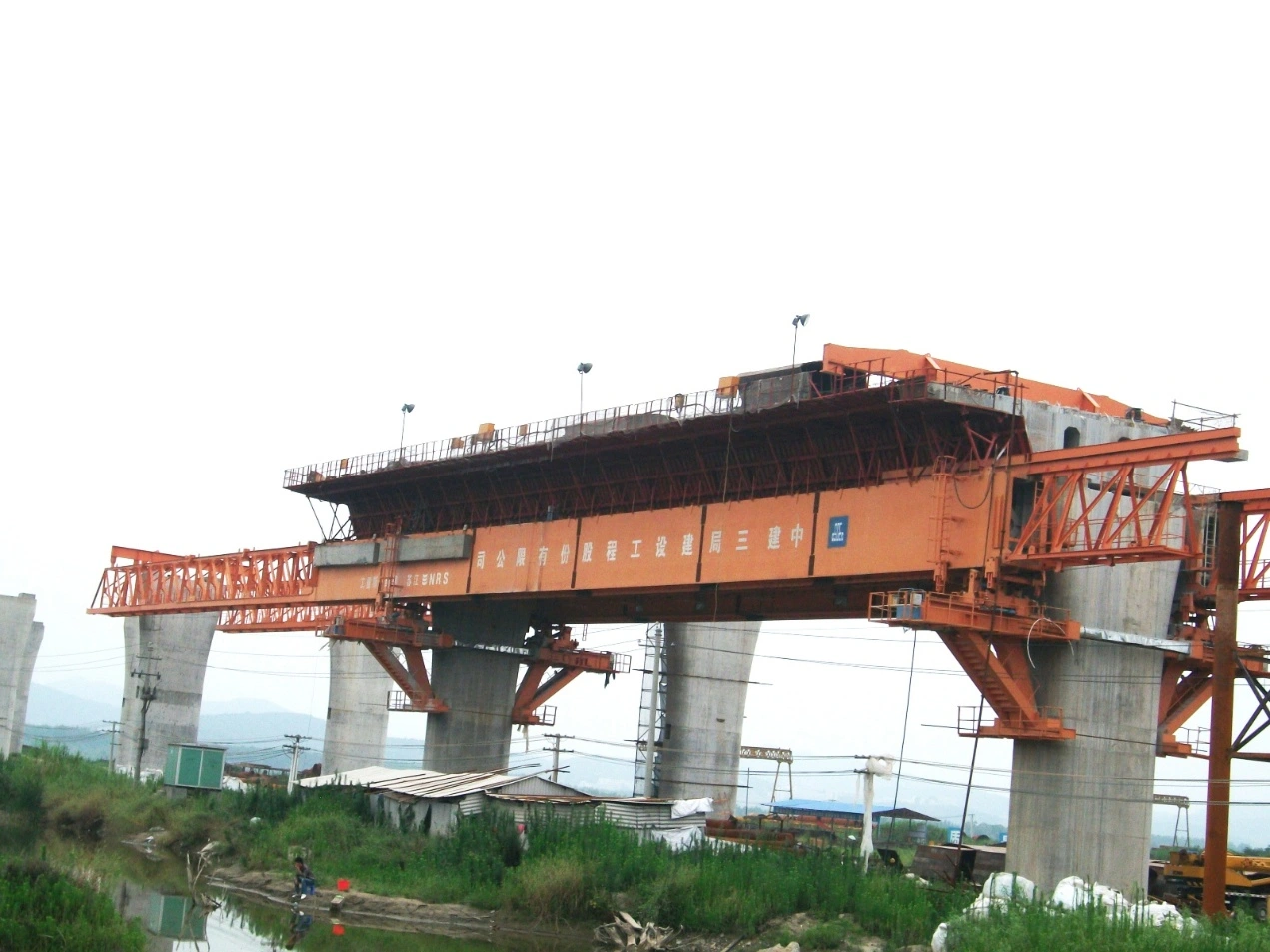
Single girder beam launchers employ a central longitudinal truss as the primary load-bearing element, distinguishing them from traditional dual-girder configurations that distribute loads across two parallel main beams. The structural architecture consists of a box-section or lattice truss main girder, typically fabricated from high-strength structural steel (S355J2 or equivalent), with transverse support frames positioned at calculated intervals to resist torsional forces during lifting operations.
The load path in single girder systems follows a vertical-to-central transfer mechanism: precast concrete segments rest on adjustable support saddles mounted atop the main girder, with forces transmitted through the truss web members to pier-mounted support legs. This configuration requires enhanced torsional rigidity compared to dual-girder systems, achieved through diagonal bracing within the main girder cross-section and stabilizing outriggers that extend laterally during lifting cycles.
Key Cantilever Features:
- Cantilever extensions at the front end, typically 8-12 meters in length
- Hydraulic adjustment mechanisms for precise alignment
- Segment positioning tolerances of ±5mm in both horizontal and vertical planes
The cantilever design allows the single girder beam launcher to “walk” forward after each segment placement, with rear support legs releasing and repositioning while front supports maintain stability.
Comparison with Dual-Girder Beam Launchers
The fundamental distinction between single girder beam launchers and dual-girder systems lies in lateral footprint and stability methodology. Dual-girder launchers typically require working widths of 12-16 meters to accommodate two parallel main beams spaced 8-12 meters apart, with transverse connection beams providing inherent lateral stability. Single girder systems reduce this footprint to 6-9 meters total width, including stabilizing outriggers, representing a 40-50% reduction in lateral clearance requirements.
This compactness introduces specific engineering trade-offs. Single girder beam launchers experience higher torsional stress during asymmetric loading conditions, necessitating more robust anti-rotation mechanisms such as hydraulic leveling systems and real-time load monitoring. Dual-girder configurations distribute torsional forces between two widely spaced beams, providing natural resistance to lateral instability but requiring significantly more site preparation and clearance.
Weight distribution also differs substantially. A typical single girder launcher for 30-meter spans weighs 180-220 tonnes, with load concentrated along the central axis. Equivalent dual-girder systems weigh 250-320 tonnes but distribute this mass across a broader base, resulting in lower ground bearing pressures at support points. For sites with limited pier cap dimensions or weight restrictions, single girder beam launchers offer advantages despite higher unit loading on support structures.
Load capacity ranges overlap significantly between configurations. Single girder beam launchers typically handle segment weights of 80-150 tonnes for spans up to 40 meters, while dual-girder systems extend to 200+ tonnes for spans exceeding 50 meters. The selection threshold depends on project-specific span lengths and segment weights rather than absolute capacity limitations.

Operational Advantages in Confined Work Zones
Reduced Lateral Clearance Requirements
Single girder beam launchers excel in environments where lateral space constraints prohibit conventional equipment deployment. Minimum working width specifications typically range from 6.5 to 8.5 meters, measured from the outermost extent of stabilizing outriggers during operation. This compact profile enables construction in urban corridors where buildings, utilities, or property boundaries restrict lateral access to within 1-2 meters of the bridge alignment centerline.
Urban viaduct projects represent the primary application domain for single girder systems. In metropolitan areas where elevated highways traverse densely developed districts, construction must proceed above active roadways, pedestrian zones, and commercial properties. Single girder beam launchers can operate within the bridge deck footprint plus minimal overhangs, eliminating the need for extensive temporary works or property acquisition that dual-girder systems would require.
Railway and highway proximity scenarios impose strict clearance envelopes defined by transportation authority regulations. When constructing bridge crossings over active rail lines, for example, equipment must remain within designated work zones typically 3-4 meters from track centerlines. Single girder systems can position their main support structures on pier caps while maintaining required clearances, whereas dual-girder configurations often necessitate track closures or complex temporary shoring systems.
Mountain highway projects encounter lateral constraints from terrain rather than urban development. Where bridge alignments follow narrow valleys or traverse steep slopes, construction equipment must operate on limited pier cap surfaces without extending into unstable soil zones or requiring extensive cut-and-fill operations. The concentrated footprint of single girder beam launchers reduces geotechnical preparation costs and environmental disturbance in sensitive terrain.
Maneuverability and Assembly Efficiency
Modular transport dimensions directly impact project mobilization logistics and costs. Single girder beam launchers disassemble into components typically not exceeding 3.5 meters in width and 12-15 meters in length, allowing transport on standard flatbed trailers without special permits or route restrictions in most jurisdictions. Main girder sections transport in 2-4 segments, depending on total launcher length, with hydraulic systems, support legs, and control cabins are transportedte modules.
On-site assembly time for single girder systems averages 5-7 working days with a crew of 8-12 technicians, compared to 10-14 days for equivalent dual-girder configurations. The reduced component count and simpler connection details—primarily bolted joints with hydraulic pin connections—accelerate assembly while minimizing specialized tooling requirements. This efficiency translates to earlier revenue-generating construction activities and reduced preliminary costs.
Crane dependency represents a critical consideration for remote or congested sites. Single girder launcher assembly typically requires a mobile crane in the 100-150 tonne capacity range for main girder section lifting, with smaller cranes (25-50 tonnes) sufficient for auxiliary components. Dual-girder systems often necessitate 200+ tonne cranes for parallel beam positioning, which may be unavailable or prohibitively expensive in certain regions. The reduced crane requirements of single girder systems expand their applicability to projects with limited heavy-lift resources.
Repositioning between construction spans follows a self-launching sequence requiring 6-8 hours per cycle. The launcher advances along completed deck segments using hydraulic jacking systems at support points, with front support legs extending to the next pier while rear supports release sequentially. This autonomous advancement capability eliminates the need for auxiliary cranes during normal operations, reducing daily operational costs and schedule dependencies on external equipment availability.
Performance Specifications and Compliance Standards
Load Capacity and Span Range
Single girder beam launchers are engineered for specific performance envelopes defined by maximum segment weight, span length, and cycle time parameters. Standard configurations handle precast concrete segments weighing 80-120 tonnes for span lengths of 25-35 meters, representing the most common specifications in highway and railway viaduct construction. Heavy-duty variants extend capacity to 150 tonnes for spans up to 40 meters, accommodating wider deck sections or higher concrete densities.
Cycle time per segment—the interval from positioning the launcher to completing segment installation and advancing to the next span—averages 3-5 days under optimal conditions. This includes launcher positioning (4-6 hours), segment lifting and alignment (6-8 hours), post-tensioning and connection work (16-24 hours), and launcher advancement (6-8 hours). Actual cycle times vary based on segment complexity, weather conditions, and crew experience, with mature projects achieving 2.5-day cycles.
| Parameter | Single Girder Launcher | Dual Girder Launcher |
|---|---|---|
| Working Width | 6.5 – 8.5 m | 12 – 16 m |
| Max Load Capacity | 80 – 150 tonnes | 120 – 200+ tonnes |
| Span Range | 25 – 40 m | 30 – 60 m |
| Assembly Time | 5 – 7 days | 10 – 14 days |
| Typical Applications | Urban viaducts, restricted corridors, mountain highways | Long-span bridges, open terrain, high-capacity projects |
| Transport Width | ≤ 3.5 m (modular) | 3.5 – 4.5 m (larger modules) |
| Crane Requirement | 100 – 150 tonne | 200+ tonne |
The span range limitation of single girder systems stems from structural efficiency considerations rather than absolute engineering constraints. As span lengths increase beyond 40 meters, the main girder cross-section must enlarge to maintain deflection limits and stress margins, resulting in weight penalties that diminish the system’s economic advantages. For projects requiring spans exceeding 45 meters, dual-girder configurations typically offer superior cost-effectiveness despite their larger footprint.
Safety and Regulatory Compliance
Single girder beam launchers must comply with EN 12999 (Crane Safety – Loader Cranes) and ISO 4306 (Cranes – Vocabulary) standards in European markets, with equivalent national standards such as ASME B30.2 in North America and GB/T 14406 in China. These regulations establish design load factors, structural analysis methodologies, and testing protocols to ensure equipment integrity under operational and environmental loading conditions.
Anti-overturning systems constitute critical safety features for single girder configurations due to their higher center of gravity relative to base width compared to dual-girder systems. Modern launchers incorporate multiple redundant safety mechanisms: hydraulic leveling systems with ±0.5-degree accuracy, real-time load moment indicators that alert operators to approaching stability limits, and automatic shutdown interlocks that prevent operations exceeding design parameters.
Wind load resistance specifications typically limit operations to wind speeds below 12-15 m/s (Beaufort scale 6), with equipment designed to withstand survival wind speeds of 35-40 m/s in the parked configuration with segments secured. Anemometers mounted on the launcher structure provide continuous wind monitoring, with automatic alarms and operational lockouts when thresholds are exceeded.
Operator certification requirements vary by jurisdiction but generally mandate specialized training in beam launcher operations beyond standard crane operator qualifications. Training programs typically span 3-5 days and cover hydraulic system operation, load calculation procedures, emergency response protocols, and equipment-specific maintenance requirements. Annual recertification and equipment-specific familiarization ensure operator competency throughout the project duration.
Commercial Value and Project Suitability
Cost-Benefit Analysis for Restricted Sites
Equipment acquisition costs for single girder beam launchers range from $800,000 to $1.5 million depending on capacity and customization requirements, representing 60-75% of equivalent dual-girder system costs. For ,contractors executing multiple projects with similar span and capacity requirements, ownership provides strong economic advantages through asset utilization across 8-12 years of service life. Rental options typically cost 3-5% of the purchase price per month, making rental a practical choice for single projects or initial market entry.
Labor cost savings emerge from reduced crew requirements and faster cycle times. Single girder operations typically require 6-8 personnel per shift (equipment operator, riggers, survey crew, maintenance technician) compared to 10-12 for dual-girder systems. Combined with 15-20% faster cycle times due to simplified positioning and reduced assembly complexity, labor cost reductions of 20-30% per installed segment are achievable on restricted sites where single girder beam launchers eliminate the need for extensive temporary works.
Project timeline compression delivers substantial indirect cost benefits through reduced preliminary and general costs, earlier revenue generation for toll facilities, and minimized traffic disruption penalties in urban environments. A 50-span viaduct project might achieve a 3-4 month schedule reduction using single girder launchers compared to conventional methods requiring extensive falsework or dual-girder systems with prolonged mobilization periods. At typical preliminary cost rates of $150,000-$250,000 per month, this schedule compression generates significant savings beyond direct equipment costs.
Site preparation costs strongly favor single girder beam launchers on restricted sites. The reduced lateral footprint minimizes temporary works such as working platforms, access roads, and utility relocations. On urban projects where property acquisition or temporary easements would be required for dual-girder equipment, single girder systems may eliminate these costs, generating savings of $500,000-$2 million depending on local property values and regulatory requirements.
Ideal Application Scenarios
Single girder beam launchers have become the preferred choice for several challenging bridge construction environments. Key ideal applications include:
- Urban viaduct construction: Particularly elevated highway sections traversing developed areas where lateral access is tightly constrained by buildings, utilities, and property boundaries. Projects with span lengths of 25-35 meters and segment weights of 80-120 tonnes align optimally with single girder capabilities.
- Mountain highway projects: Where bridge alignments follow narrow valleys, traverse steep slopes, or cross environmentally sensitive areas. The compact footprint minimizes site disturbance and reduces geotechnical preparation requirements while lowering environmental impact in protected zones.
- Railway overpass construction: Demanding precise clearance management and minimal disruption to active rail operations. Single girder systems can position support structures on pier caps while maintaining required clearances, often eliminating track closures or complex temporary shoring.
- Bridge renovation and widening projects: Working adjacent to existing structures. The compact lateral profile enables the construction of new spans alongside operational bridges without requiring lane closures or extensive temporary supports.
This application is increasingly relevant as aging infrastructure requires capacity expansion while maintaining traffic flow during construction.
FAQ
Q1: What is the minimum working width required for a single girder beam launcher?
Minimum working width for single girder beam launchers typically ranges from 6.5 to 8.5 meters, measured from the outermost extent of stabilizing outriggers during lifting operations. This includes the main girder width (typically 2.5-3.5 meters) plus lateral stabilizing outriggers that extend 2-2.5 meters on each side.
Single girder systems consistently require 40-50% less lateral clearance than dual-girder alternatives. Actual requirements depend on specific equipment configuration and segment dimensions. Site-specific assessments should account for safety buffer zones and temporary works access, typically adding 1-2 meters to the equipment footprint.
Q2: Can single girder launchers handle the same load capacity as dual-girder systems?
Single girder beam launchers can handle segment weights of 80-150 tonnes for spans up to 40 meters, covering the majority of highway and railway viaduct applications. Dual-girder systems extend to 200+ tonnes for spans exceeding 50 meters.
The capacity overlap is substantial in the common 25-40 meter span range. Selection depends on project-specific requirements: if segment weights exceed 150 tonnes or spans exceed 40 meters, dual-girder systems become necessary. For typical viaduct construction within these parameters, single girder systems provide adequate capacity with significant advantages in footprint and overall project costs.
Q3: What are the typical lead times for procurement and site mobilization?
Equipment procurement lead times for single girder beam launchers range from 6-9 months for standard configurations to 12-15 months for customized heavy-duty variants, depending on manufacturer capacity and specification complexity. Rental equipment may be available with 2-4 month lead times if suitable units exist in the lessor’s fleet.
Site mobilization requires 2-3 weeks for equipment transport and 5-7 days for on-site assembly with an experienced crew. Total timeline from order placement to operational readiness spans 7-10 months for purchase scenarios or 3-4 months for rental. Early equipment planning during project design phases is essential to avoid schedule impacts.
Conclusion
Single girder beam launchers deliver significant advantages for bridge projects facing limited lateral space, urban density, or challenging terrain. The 40-50% reduction in working width compared to dual-girder systems makes them highly effective in urban corridors, railway proximities, and mountain areas where conventional equipment would be impractical or too costly.
While technical trade-offs in load capacity and stability must be evaluated against project needs, single girder systems offer the best balance for typical viaduct projects with 25-40 meter spans and 80-150 tonne segments. Larger or heavier projects may still favor dual-girder configurations.
Beyond lower equipment costs, single girder beam launchers provide 20-30% labor savings and 3-4 month schedule compression on typical 50-span projects, delivering strong return on investment in space-restricted environments.
By understanding their capabilities, contractors and developers can optimize equipment selection for better efficiency and cost control in demanding conditions.