



Innleiing
A lansering av gantri—that massive steel structure gliding above bridge piers—is rewriting the rules of large-scale bridge construction. It’s not only faster and more cost-effective. It’s safer, more precise, and significantly less disruptive than traditional methods, making it a game-changer for engineers and contractors handling complex bridge projects.
In an era where global infrastructure spending is surging, the bridge construction market alone is projected to grow from USD 1.27 trillion in 2025 to USD 1.87 trillion by 2032, creating unprecedented pressure to adopt smarter and more efficient building methods.
So why is a launching gantry rapidly becoming the go-to solution for mega-projects worldwide? In the following sections, we’ll break down the real advantages—not generic claims, but insights drawn from some of the most ambitious and high-profile bridge projects on the planet.
What Exactly Is a Launching Gantry? (And Why Should You Care?)
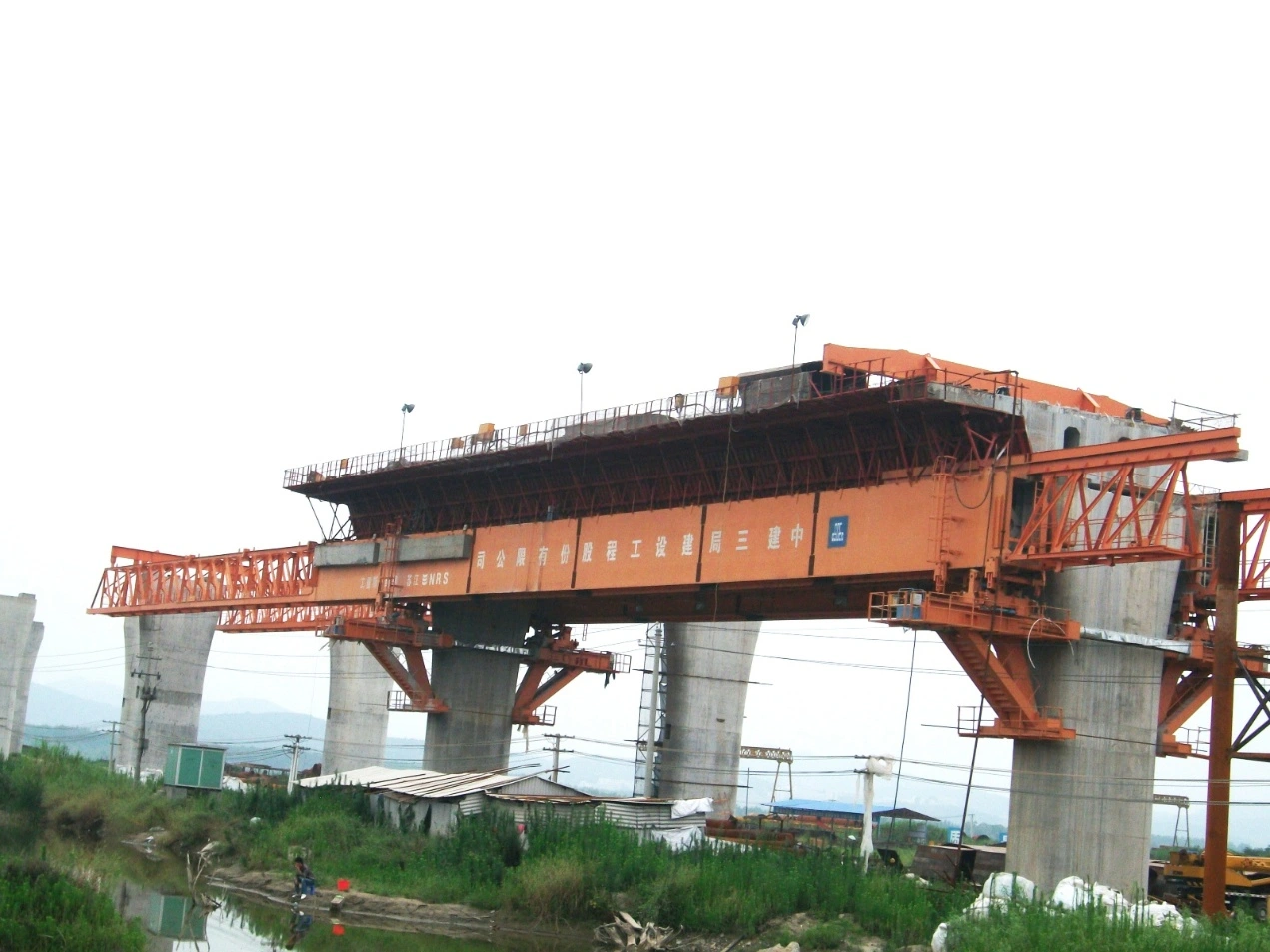
A lansering av gantri (also referred to as a bridge launching girder or deck erection gantry) is a specialized truss system designed to lift, transport, and precisely position precast concrete or steel bridge segments. Unlike conventional cranes that depend on ground‑level access, a launching gantry operates directly above the bridge alignment, moving from span to span without disassembly—a capability known as self‑launching.
Think of it as a mobile assembly line in the sky.
The market is taking notice. The global bridge launching gantries market was valued at USD 1.24 billion in 2024 and is forecast to reach USD 2.13 billion by 2033, growing at a CAGR of 6.1%. The broader segmental bridge construction equipment market, which includes launching gantries, is expanding even faster at a CAGR of 6.2%. Why the surge? Because infrastructure owners and contractors are tired of budget overruns, delayed timelines, and environmental headaches. A lansering av gantri addresses all three.
The 6 Core Advantages of Using a Launching Gantry for Large Bridges
Let’s get specific. Here’s what a lansering av gantri brings to the table—and why it’s outperforming traditional methods.
1: How a Launching Gantry Ensures Millimeter-Level Precision
A launching gantry achieves millimeter-level accuracy when placing precast segments. This precision is not optional—it’s critical for the structural integrity and longevity of the bridge. Perfectly aligned segments ensure uniform load distribution, minimize stress points, and help the bridge perform as designed for decades.
Real-world example: On the Mfuti Bridge in Kinshasa, DR Congo, a dual-girder, self-balancing launching gantry with a rated capacity of 160 metric tons installed precast T-beams for a 120-meter bridge. According to China Railway Resources Group, the gantry’s dual-girder design maintained balance throughout installation, reducing pressure on the bridge surface. Liu Yufeng, head of the construction team, stated:
“Compared with traditional machines, this gantry is more stable and better suited to complex construction scenarios.”
2: How a Launching Gantry Cuts Construction Time Dramatically
Traditional methods often involve stop-and-go workflows. A launching gantry automates lifting, transport, and placement, significantly compressing the construction schedule.
Example: During the Park Avenue Viaduct Replacement in New York City, a movable launching gantry delivered extraordinary results:
- 128 bridge installations completed in 19 weekends
- Total of 8,240 track feet installed
- Metro-North train service remained fully operational
- Structural work finished 21 months ahead of schedule
- Project USD 93 million under budget
This demonstrates how a launching gantry can transform project economics while keeping ongoing operations uninterrupted.
3: How a Launching Gantry Keeps Construction Teams Safer
Conventional bridge construction exposes workers to hazards such as heights, suspended loads, and crane coordination. A launching gantry reduces these risks by operating directly above the piers, minimizing worker exposure.
Its self-launching feature also eliminates repeated disassembly and reassembly cycles—the moments when most accidents occur. When the gantry moves itself to the next span, crews remain on stable ground.
4: How a Launching Gantry Handles Curves, Slopes, and Urban Challenges
Modern bridges rarely follow straight lines. Urban transit projects often feature tight curves, steep grades, variable slopes, and wide decks. The hinged launching gantry excels in these scenarios.
Developed by NRS in the early 1990s, the hinged design allows articulation on horizontal curves as tight as 75 meters for a 40-meter span. Hydraulic cylinders control up to six hinges, enabling smooth traversal even in complex metro and light rail projects.
Additionally, modern gantries support both balanced cantilever and span-by-span erection. They can also climb vertically to manage steep longitudinal grades—ideal for mountainous terrain or elevated urban viaducts.
5: How a Launching Gantry Minimizes Environmental Impact
You might be surprised that a massive steel structure can be “green.” By operating above the bridge deck, a launching gantry avoids temporary ground supports, access trestles, and scaffolding, reducing environmental disruption.
Example: On Interstate 81 in De Witt, New York, contractors deployed twin gantries to add 15 spans over wetlands and an active rail yard. Traditional cranes would have disturbed ecosystems and traffic, but the gantries:
- Required no ground contact
- Allowed continuous rail operations
- Lifted 60 steel girders, every 30.8 tons, within a single week
This principle also applies to river crossings, valleys, and congested urban areas, reducing permits, environmental impact, and community complaints.
6: How a Launching Gantry Saves Labor and Reduces Costs
A single launching gantry can replace multiple cranes, reducing equipment rental costs, simplifying logistics, and lowering total labor requirements.
Case study: A 2019 academic study comparing launching gantries with traditional trestle systems for precast segmental box girder erection found measurable cost advantages—especially for projects with repetitive spans, where gantry reuse maximized efficiency.
Furthermore, launching gantries are designed for redeployment. Core truss systems can be adapted for new projects, and fabrication drawings can be shared with local steel fabricators, saving on transportation and supporting regional industries.

How a Launching Gantry Compares to Traditional Methods
Let’s make this concrete. Below is a head‑to‑head comparison between a lansering av gantri and traditional crane‑based erection methods (using mobile cranes or crawler cranes with ground access).
| Aspect | Fråsegleport | Traditional Crane Method |
|---|---|---|
| Ground Access Required | None—operates above deck | Extensive—requires stable, cleared ground |
| Environmental Disruption | Minimal—no trestles or temporary supports | High—ground disturbance, vegetation removal |
| Precision of Segment Placement | Millimeter‑level, controlled via hydraulic systems | Dependent on the crane operator’s skill |
| Speed (Spans per Week) | 2–4 spans (depending on complexity) | 1–2 spans with significant setup/teardown |
| Working in Tight Curves | Excellent—hinged designs handle radii as tight as 75m | Poor—requires multiple crane repositionings |
| Self‑Launching Capability | Yes—moves to next span without disassembly | No—each span requires new crane positioning |
| Labor Requirements | Small specialized crew | Larger team for crane operation, rigging, and coordination |
| Traffic/Service Disruption | Minimal—can work above active train lines or roads | High—often requires lane or track closures |
| Capital Investment | Higher upfront | Lower upfront but higher cumulative costs |
| Reusability Across Projects | High—designed for multiple deployments | Low—cranes are general‑purpose but less specialized |
For large‑scale, repetitive‑span projects or those in sensitive or constrained environments, a launching gantry delivers superior speed, safety, and cost‑effectiveness over the life of the project. The higher initial investment pays for itself—often multiple times over—in schedule acceleration and reduced ancillary costs.
Real‑World Applications Where Launching Gantries Excel
A lansering av gantri isn’t the right tool for every bridge. But in certain scenarios, it is the only logical choice.
-
Metro and Light Rail Viaducts
Tight curves, urban constraints, and the need to maintain existing train service—these are the hallmarks of modern mass transit projects. NRS’s hinged launching gantry has been proven successful in precisely these environments. In Singapore, the Land Transport Authority (LTA) even held a special naming ceremony for the North South Corridor N112 launch gantry, christening it “Shùn Shùn Ān” (meaning smooth and safe)—a testament to the equipment’s cultural and operational significance.
-
Overwater Crossings
When a bridge must span a river, estuary, or bay, ground access is often impossible. A launching gantry works entirely above the waterline. In Spain’s Port of Ferrol, Mammoet oversaw the final 397‑meter segment of a bridge launch over water, using a temporary gantry system to safely move bridge segments during each stage. The operation involved four separate launches and had to account for marine traffic and tidal movements—challenges that a ground-based crane simply couldn’t handle.
-
Precast Segmental Bridges Over Valleys and Remote Terrain
The Panama Fourth Bridge project, a major crossing over the Panama Canal, adopted a precast segmental box girder system with dedicated precasting yards on both banks. Construction used a combination of short‑line match casting and bridge launching gantry erection techniques. This approach minimizes on-site concrete pouring, reduces material waste, and allows construction to proceed even in remote or logistically challenging locations.
-
Highway Viaducts with Repetitive Spans
For long viaducts with identical or similar spans, a lansering av gantri becomes an assembly line. The LG50‑S, an overhead movable launching gantry, built 43 spans of the Anita Garibaldi Bridge in Laguna, Brazil—each span 50 meters long, composed of 14 segments weighing approximately 90 tons each. The repetitive nature of the work made the launching gantry the ideal choice.
Technology and Design Innovations Driving the Future
-
The Hinge Concept for Extreme Curves
As noted earlier, the hinged launching gantry is a game‑changer for curved bridges. NRS has supplied special hinged under‑slung gantries with up to 12 hinges to accommodate horizontal curvature down to 75‑meter radii. Each hinge is regulated by hydraulic cylinders, allowing fine‑tuned articulation during both segment erection and gantry launching.
-
Self‑Launching Mechanics
Modern self‑launching gantries are more than twice as long as the typical span they erect. This increased length improves longitudinal stability, accelerates repositioning, and shortens the overall span cycle time. The winch‑trolley can be operated freely during launch, allowing the gantry to reposition its own support crossbeams without auxiliary ground cranes.
-
“Glue‑as‑You‑Go” and Segment Handling
Innovative concepts like Glue‑as‑you-go for wet joint segmental bridges reduce double handling of segments, while the Turnaround concept minimizes segment stacking within a span. These may sound like niche operational details, but on a large project, they add up to significant time savings and simpler site logistics.
-
Digital Integration and Automation
The broader bridge construction industry is embracing digital tools, and launching gantries are following suit. IoT-enabled sensors, real-time monitoring systems, and Building Information Modeling (BIM) are being integrated into modern gantry systems, enabling predictive maintenance, load monitoring, and automated adjustments. AI-assisted workflows and digital twins are becoming permanent parts of infrastructure delivery, and launching gantry operations is no exception.
The Economic Case—Why a Launching Gantry Makes Financial Sense
Let’s talk dollars and cents. A lansering av gantri represents a significant upfront capital expenditure. But in the context of today’s multi‑billion‑dollar bridge projects, the economics are compelling.
Consider the Park Avenue Viaduct: $93 million under budget and 21 months ahead of schedule. A significant portion of that savings came from using a gantry system that could work above active train lines without service disruption. Every weekend of avoided service shutdowns translated directly into retained revenue for the transit authority and lower contingency costs.
On the global scale, massive infrastructure investments are flowing into bridges. The U.S. Infrastructure Investment and Jobs Act (IIJA) dedicates $40 billion over five years to tackle the nation’s bridge backlog, with average annual bridge spending now 22% higher than under the previous authorization. In the UK, the government has committed £1 billion to repair deteriorating bridges and transport infrastructure. These projects demand equipment that can deliver results quickly, safely, and cost‑effectively.
The segmental bridge construction equipment market—including launching gantries—is projected to reach $4.1 billion by 2033. That growth is driven by the simple reality that contractors and government agencies are increasingly choosing advanced mechanization over slower, less predictable traditional methods.
FAQ
Q1: What’s the typical load capacity of a launching gantry?
A: Capacities vary widely by project. The Mfuti Bridge gantry has a rated capacity of 160 metric tons. Larger systems can handle segments exceeding 200 tons. Each gantry is custom‑engineered for specific loads.
Q2: Can a launching gantry work on bridges with steep grades or hills?
A: Yes. Modern launching gantries feature vertical climbing capabilities to accommodate tight vertical curvature and steep longitudinal falls, with hydraulic systems maintaining stability on slopes.
Q3: How long does it take to set up a launching gantry on site?
A: Assembly time varies, but many systems can be delivered, assembled, and calibrated within one to two weeks, depending on site conditions and gantry complexity.
Q4: Is a launching gantry reusable for multiple projects?
A: Absolutely. Gantries are designed for redeployment. Core truss systems can be modified for different spans and loads, making them valuable assets for contractors with multiple bridge projects.
Q5: How does a launching gantry handle bridges with variable span lengths?
A: Most gantries are designed for a specific span range, but adjustable support configurations allow adaptation. Some advanced systems can handle multiple span lengths within a single project by reconfiguring support crossbeams.
Is a Launching Gantry Right for Your Next Bridge Project?
If you’re building a large‑scale bridge with repetitive spans, challenging terrain, tight curves, or environmental sensitivities, a lansering av gantri isn’t just an option—it’s the smartest choice you can make.
The evidence is overwhelming. From the Mfuti Bridge in DR Congo (where a launching gantry filled the country’s technical gap in bridge construction) to the Park Avenue Viaduct in New York City (where a gantry system delivered structural completion 21 months ahead of schedule), the results speak for themselves. Faster construction. Lower costs. Improved safety. Minimal environmental disruption.
And with global bridge construction spending at historic highs—driven by the US IIJA, UK infrastructure commitments, and massive projects across Asia and the Middle East—the time to explore launching gantry solutions is now.
Every bridge project demands speed, precision, and cost control. Our team can provide a free consultation on how a custom launching gantry can accelerate your project. From metro viaducts to highway expansions or river crossings, we’ll help you choose the optimal configuration for your spans and loads.
Don’t let old methods slow you down. Launch your project smarter, faster, and safer.