



Introduction
Bulk material stockyards face recurring challenges, including low space utilization, high labor costs, inconsistent material blending, dust hazards, and unplanned downtime. One widely used solution is a stacker reclaimer—a rail-mounted machine designed to stack incoming bulk material and reclaim it for downstream processing.
This guide explains how a stacker reclaimer works, the main types used in industrial stockyards, how it improves operational efficiency, key design considerations for large yards, and how to select the right stacker reclaimer for your application.
What Is a Stacker Reclaimer?
A stacker reclaimer is a rail-mounted machine used to stack and reclaim bulk materials in industrial stockyards. It performs two core functions: stacking incoming material onto stockpiles in controlled patterns, and reclaiming stored material for shipment or further processing.
These machines are rated by capacity in tonnes per hour (t/h) and are fundamental to modern bulk material handling systems in mining, power generation, cement, steel, and port terminals. A reclaimer alone recovers material, while a stacker alone builds piles. A combined unit integrates both operations, saving space and cost for medium-throughput facilities.
How a Stacker Reclaimer Works in Stockyards
The working principle separates stacking and reclaiming modes. Understanding both is essential for yard design.
Stacking – Building the Stockpile
In stacking mode, the machine receives bulk material from a yard conveyor via a tripper car or boom belt conveyor. Material travels to the machine and is discharged from the boom end onto the stockpile. The boom adjusts in three ways:
-
Luffing (vertical movement) – Controls discharge height to minimize dust and degradation.
-
Slewing (rotational movement) – Spreads material across a wide arc.
-
Travelling (horizontal rail movement) – Allows the machine to serve multiple stockpile zones.
Different stacking patterns suit different materials and blending needs:
-
Chevron stacking – The machine travels end-to-end over the pile centre line. Fine particles accumulate near the centre; coarse particles roll to the sides.
-
Windrow stacking – Material deposited from multiple positions across the pile width, preventing segregation. Ideal for sticky clay or dry limestone blends.
-
Cone shell stacking – Material deposited from a fixed position into a single cone. Once full, the discharge point moves to a new location. Simple, but no blending.
Because the boom can swivel and adjust inclination, modern machines can perform cone-shell, strata, chevron, and windrow patterns.
Reclaiming – Retrieving Stored Material
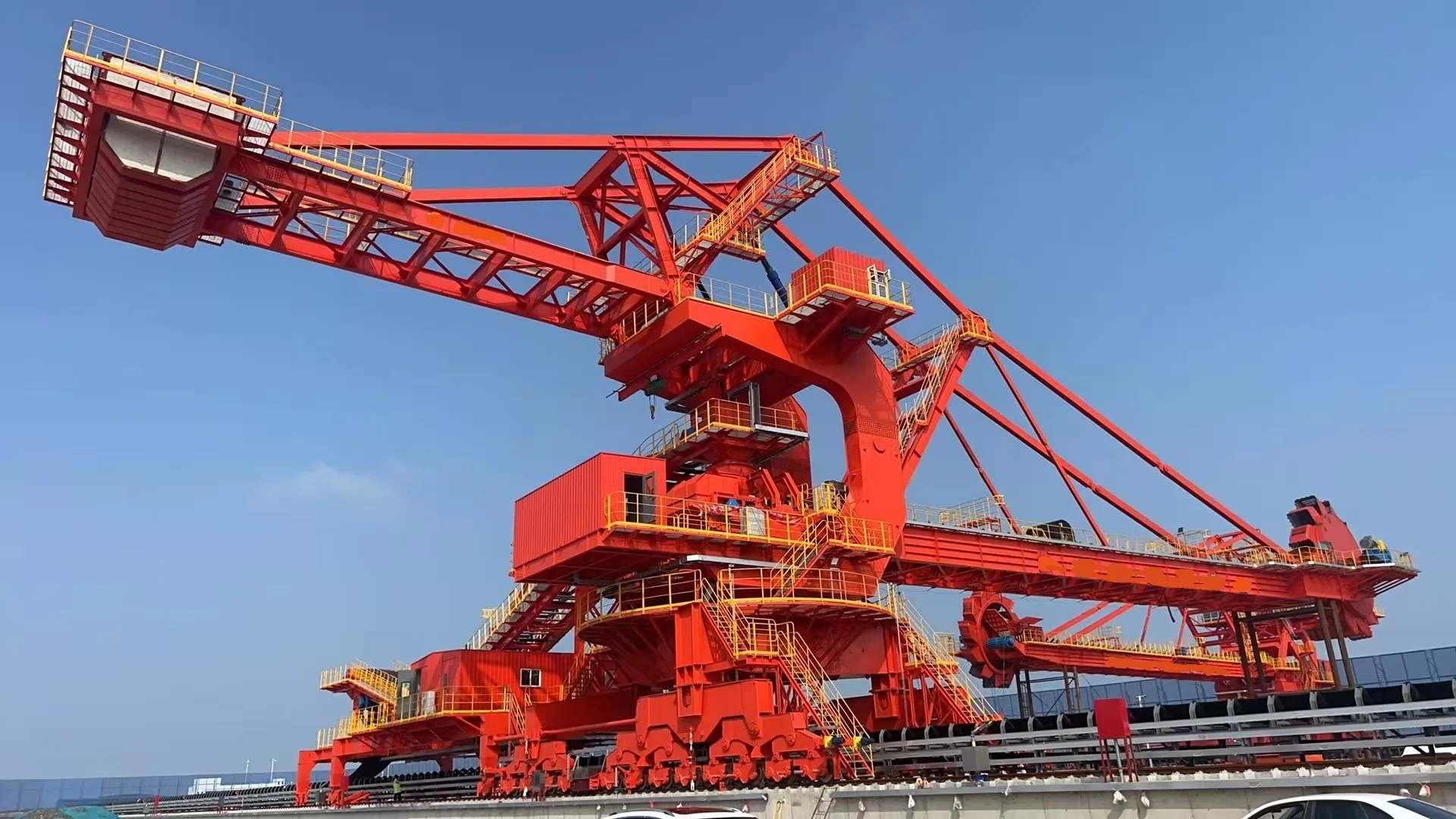
In reclaiming mode, the same machine (or a dedicated reclaimer) removes material and sends it back to the yard conveyor. The most common mechanism is the bucket wheel – a rotating wheel with buckets that scoop material from the pile face and drop it onto a conveyor.
The bucket wheel sits within the gantry – the main structural frame housing drive systems, operator cabin, and electrical controls. As the machine travels along the stockpile, the bucket wheel continuously excavates, maintaining a steady flow.
For stockpile reclaiming, material is scooped, transported to the rotation center via a reversible belt conveyor, dumped into a central chute, and then transferred onto the discharge conveyor running between the rails. The gantry travels on rail trucks – typically multiples of four – enabling horizontal movement across the yard.
Where the reclaim rate is relatively constant (e.g., power plant feed), the unit’s capacity needs only slightly to exceed the required rate. For batch transport, such as ships, the reclaimer and shiploader are often rated at nearly twice the average loading rate due to hatch changes and berthing delays. Trains and trucks typically require a surge bin immediately before load-out.
Types of Stacker Reclaimer Systems and Their Uses
Selecting the right type depends on material, yard layout, and throughput.
By Reclaiming Mechanism
-
Bucket wheel stacker reclaimers – Most common. Use a rotating bucket wheel. Capacities exceed 10,000 t/h. Highly flexible. Used in ports, power plants, stockyards, and steel plants.
-
Scraper reclaimers – Use chain-mounted scrapers. Suitable for powdery materials or those prone to bridging. No bucket wheel.
By Structure
-
Portal reclaimer – Portal or semi-portal structure spanning the stockpile. Material flows underneath, saving space.
-
Bridge reclaimer – Full-width bridge structure. Blends product as it reclaims. Equipped with heavy scraper chains. Processes parallel beds and discharges via concrete ramps or drag troughs.
-
Cantilever scraper reclaimer – Long boom supported by a truss. Boom angle adjusted by cable-winch. Lowered during each reclaim cycle, creating a push-pull effect that moves material to the pile edge.
By Stockyard Configuration
-
Longitudinal stacker reclaimers – Operate along linear stockyards on rails between parallel piles. Enable blending via the chevron and windrow methods.
-
Circular stacker reclaimers – Designed for circular or dome yards. A rotating jib deposits material in a semi-circular pile. The jib arm rotates over a set arc, avoiding dead zones.
Industry Applications
-
Power generation – Coal handling for thermal plants.
-
Mining – Iron ore, bauxite, copper ore.
-
Cement production – Limestone pre-homogenization and clinker storage.
-
Steel mills – Iron ore, coke, flux yards.
-
Port terminals – Ship loading/unloading buffers.
-
Fertilizer and agriculture – Grain, potash, phosphate, urea.
Stacker Reclaimer vs. Wheel Loader – A Comparison
Many smaller yards ask: Why use a rail-mounted stacker reclaimer instead of mobile wheel loaders? The differences are significant.
| Feature | Stacker Reclaimer | Wheel Loader / Bulldozer |
|---|---|---|
| Continuous operation | Yes, 24/7 | No, requires operator breaks |
| Tonnes per man-hour | Very high (automated) | Low (manual) |
| Space utilization | High (no buffer zones needed) | Lower (requires maneuvering space) |
| Blending precision | Excellent (controlled stacking patterns) | Poor (operator-dependent) |
| Dust exposure | Low (remote/automated control) | High (operator in cab) |
| Maintenance cost per tonne | Low | High (tires, fuel, engine hours) |
| Capital cost | High | Low to moderate |
For yards handling over 500,000 tonnes per year, a stacker reclaimer typically pays for itself within 2–4 years through labor savings, reduced downtime, and better space use. Mobile loaders may have a lower upfront cost, but their higher operating cost per tonne and lower throughput make them less economical for high-volume, continuous operations.
How a Stacker Reclaimer Improves Efficiency in Industrial Operations
Efficiency gains go beyond raw throughput. Here are the key performance benefits.
-
Higher productivity – Continuous operation, moving thousands of tonnes per hour. A single loader would require multiple passes and frequent breaks.
-
Reduced labor dependency – One machine can replace multiple wheel loaders. Cubic meters per man-hour are an order of magnitude higher.
-
Improved safety – Dust is a major hazard. Automated systems remove operators from exposure. 24/7 operation even in foggy weather. Reduced mechanical shock and wear lowers maintenance costs and extends life.
-
Better space utilization – Well-designed stockyards achieve higher volumetric density. Cantilever-type bucket wheel units have arm lengths of 20–60 meters and capacities of 100–10,000 t/h.
-
Consistent blending – Controlled stacking and cross-sectional reclaiming homogenize material, reducing variability in chemical composition. Bridge scraper reclaimers with chevron stacking achieve blend ratios up to 1:10.
-
Energy efficiency – Low-resistance belt conveyors, rolling bearings in slewing mechanisms, and optimized drives reduce power consumption.
Design Considerations for Large Storage Yards
Designing a stacker reclaimer for large yards requires balancing capacity, layout, process needs, and upstream/downstream continuity.
Capacity matching. Stacking and reclaiming capacities must align with upstream and downstream equipment. Cantilever-type bucket wheel units achieve stacking capacities exceeding 10,000 t/h and reclaiming up to 8,000 t/h. Bridge-type scrapers handle 500–5,000 t/h with rail spans of 30–60 meters.
Environmental resilience. Machines operate from -50°C to +50°C. In sub-freezing conditions, harder rake materials break up ice. Automated stockpile management can include 3D target sensors for precise control and dust-suppression systems for compliance.
Live storage capacity. Rail-mounted systems provide more live storage than dozer-operated yards because no buffer zones are needed for mobile equipment. Automated pile management knows where each material is located, preventing intermixing without operator intervention.
Integration with automation. Advanced sensors – GPS for gantry and bucket wheel positioning, 3D stockpile modeling, predictive maintenance – are now standard. This optimizes performance based on stockpile models, reducing mechanical shock, wear, and maintenance costs.
Total Cost of Ownership Analysis for Stacker Reclaimers
For large-scale bulk material operations, equipment cost should be evaluated beyond the initial purchase price. While a stacker reclaimer requires higher upfront investment than mobile equipment, it typically delivers lower long-term operating costs through reduced labor, improved efficiency, and minimized downtime.
Automated operation allows continuous material handling with fewer operators, while consistent stacking and reclaiming reduce material loss and improve process stability. In high-throughput applications, these advantages often result in a more favorable total cost profile over the equipment lifecycle.
How to Choose the Right Stacker Reclaimer for Your Application
Use this step-by-step selection guide.
-
Material characteristics – Density (0.5–2.5 t/m³), lump size (typically ≤300 mm), abrasiveness, moisture, temperature. These drive wear protection and flow angle requirements.
-
Storage capacity and footprint – Calculate the required live storage volume and available land. Longitudinal yards suit large linear footprints; circular layouts minimize ground area.
-
Required throughput (t/h) – Establish both average and peak stacking and reclaiming rates, especially for batch loading (ships, trains).
-
Stacking method – Chevron (moderate blending, compact pile), windrow (better particle distribution and blending), or cone shell (simplest, no blending).
-
Reclaiming mechanism – Bucket wheel (highest continuous rates, flexible). Scraper (for friable or sticky materials). Bridge scraper (superior homogenization).
-
Automation level – Manual, semi-automated, or fully automated. Automated units include PLC programming, remote operation, and sensor-guided pile management.
-
Climate and environmental factors – Dusty areas require sealed galleries and dust suppression. Extreme temperatures may need specialized materials.
Example selection case: A cement plant handling 2,000 t/h of limestone with a stockyard length of 400 meters chooses a cantilever bucket wheel stacker reclaimer. Material density is 1.6 t/m³, lump size up to 80 mm. Chevron stacking is selected for moderate blending. The unit is specified with 3,000 t/h stacking capacity, 2,500 t/h reclaiming capacity, and semi-automated control. The estimated capital cost is recovered in 3 years through reduced loader usage and blend consistency improvement.
Common Faults and Preventive Maintenance for Stacker Reclaimers
Even well-designed stacker reclaimers experience wear and occasional failures. Recognizing early warning signs prevents unplanned downtime.
Wheel and rail wear. The travel mechanism runs on steel rails. Uneven wear can cause alignment issues and increased power consumption. Regular rail grinding and wheel profile inspections every 500 operating hours extend component life.
Bucket wheel wear. Buckets and cutting edges are exposed to abrasive materials. Inspect for cracks, deformation, or worn cutting edges monthly. Replace buckets when the edge thickness reduces by more than 30% of the original.
Conveyor belt tracking. Misalignment leads to edge damage and spillage. Check belt tracking weekly, especially after rain or material buildup on pulleys.
Boom luffing system issues. Hydraulic or wire-rope luffing systems can develop leaks or rope wear. Monitor hydraulic oil levels daily. Replace wire ropes every 6–12 months, depending on duty cycle.
Slewing bearing failure. The slewing ring supports the entire boom structure. Unusual sounds or increased backlash indicate bearing degradation. Perform annual grease analysis and visual inspection.
Dust suppression system blockages. Nozzles clog over time. Clean or replace nozzles quarterly. Ensure water pressure is adequate for the system design.
A preventive maintenance schedule with daily, weekly, monthly, and annual tasks reduces unexpected failures by up to 60% compared to reactive maintenance. Keep detailed logs of operating hours, inspections, and repairs to predict component life.
Spare Parts Inventory Recommendations
To minimize downtime, maintain a strategic spare parts inventory. Recommended minimum stock levels for a single stacker reclaimer:
-
Critical spares (keep on-site): Two sets of bucket wheel cutting edges, one spare conveyor belt section (50m), one set of idler rollers (10 units), one wire rope for luffing, and one hydraulic power pack.
-
Consumables (keep in warehouse): Bearings (4 units), seals (10 sets), lubricants (500L), electrical contactors (5 units), sensors (3 units).
-
Long-lead items (order when wear reaches 50%): Bucket wheel hub assembly, slew bearing, gearbox.
For fleets of multiple units, consolidate inventory and negotiate consignment stock agreements with the manufacturer. Typical spare parts inventory investment is 3–5% of capital cost, reducing average downtime per failure from weeks to hours.
Future Trends in Stacker Reclaimer Technology
Modern stacker reclaimers are increasingly integrated with advanced monitoring and automation technologies. Features such as predictive maintenance, sensor-based control systems, and digital modeling are helping improve reliability, reduce downtime, and optimize stockyard operations. As industrial automation continues to evolve, these technologies are expected to further enhance equipment performance and operational efficiency.
Market Trends and Growth Drivers
The stacker reclaimer market expanded from USD 1.22 billion in 2025 to USD 1.34 billion in 2026, a CAGR of 7.17%, and is projected to reach USD 1.99 billion by 2032.
Key drivers include digital integration, automation readiness, environmental compliance, and strategic sourcing. Stockyard machinery is increasingly seen as a production enabler, not just storage. Digital controls, sensor integration, and automation lead procurement criteria. Environmental compliance – dust and energy management – influences permitting and community acceptance.
Segment-specific requirements matter: abrasive ore handling stresses wear parts; coal operations demand moisture and safety strategies; cement and aggregates prioritize feed consistency.
Regional insights. Asia-Pacific dominates the market, accounting for over 40% of global demand, driven by rapid industrialization in China, India, and Southeast Asia. China alone plans to add over 500 million tonnes of coal handling capacity at new power plants by 2030. India’s mining sector is expanding at 8% annually, requiring modern stockyard equipment. Europe and North America focus on retrofitting older yards with automated stacker reclaimers to improve efficiency and reduce emissions. The Middle East and Africa show strong growth in cement and phosphate handling.
Technology adoption rates. Fully automated stacker reclaimers now represent approximately 25% of new installations, up from 12% five years ago. Semi-automated units account for 45%. The shift is driven by labor cost reduction and safety improvements. Predictive maintenance systems using IoT sensors and machine learning are becoming standard on premium models, reducing unplanned downtime by an average of 35% according to industry reports.
FAQ
Q1: What is a stacker reclaimer used for?
A stacker reclaimer is used to automatically stack incoming bulk material onto stockpiles and reclaim stored material for downstream processing, shipping, or feeding into production lines.
Q2: How does a stacker reclaimer work in stockyards?
In stacking mode, material discharges from a boom conveyor onto a stockpile while the boom luffs, slews, and travels. In reclaiming mode, a bucket wheel or scraper excavates material and transfers it to a yard conveyor.
Q3: What are the main types of stacker reclaimers?
Main types include bucket wheel, scraper, portal, bridge, cantilever, longitudinal, and circular systems.
Q4: How do I choose the right stacker reclaimer?
Consider material characteristics, throughput (t/h), stockyard footprint, stacking method, reclaiming mechanism, automation level, and environmental conditions.
Q5: What industries use stacker reclaimers?
Power generation (coal handling), mining (ore processing), cement production (limestone homogenization), steel mills, port terminals, and fertilizer handling.
Conclusion
A stacker reclaimer solves the core challenges of bulk material handling: inefficient space use, high labor costs, inconsistent blending, dust hazards, and unplanned downtime. By automating stacking and reclaiming, this equipment delivers higher productivity, better safety, superior space utilization, and consistent material quality.
Understanding the working principle, types, efficiency drivers, design considerations, and selection criteria enables operators and engineers to make informed investment decisions. For yards handling over 500,000 tonnes annually, a rail-mounted stacker reclaimer is often the most cost-effective long-term solution.
Ready to improve your stockyard operations? We offer a range of stacker reclaimers for mining, ports, power plants, and industrial stockyards. Please feel free to contact us anytime with any questions or needs.