



Introduction
Every bridge project must balance construction efficiency, safety, and cost. Traditional cast-in-situ methods using ground-based scaffolding and falsework often require extensive materials, labor, and site preparation, resulting in longer construction cycles.
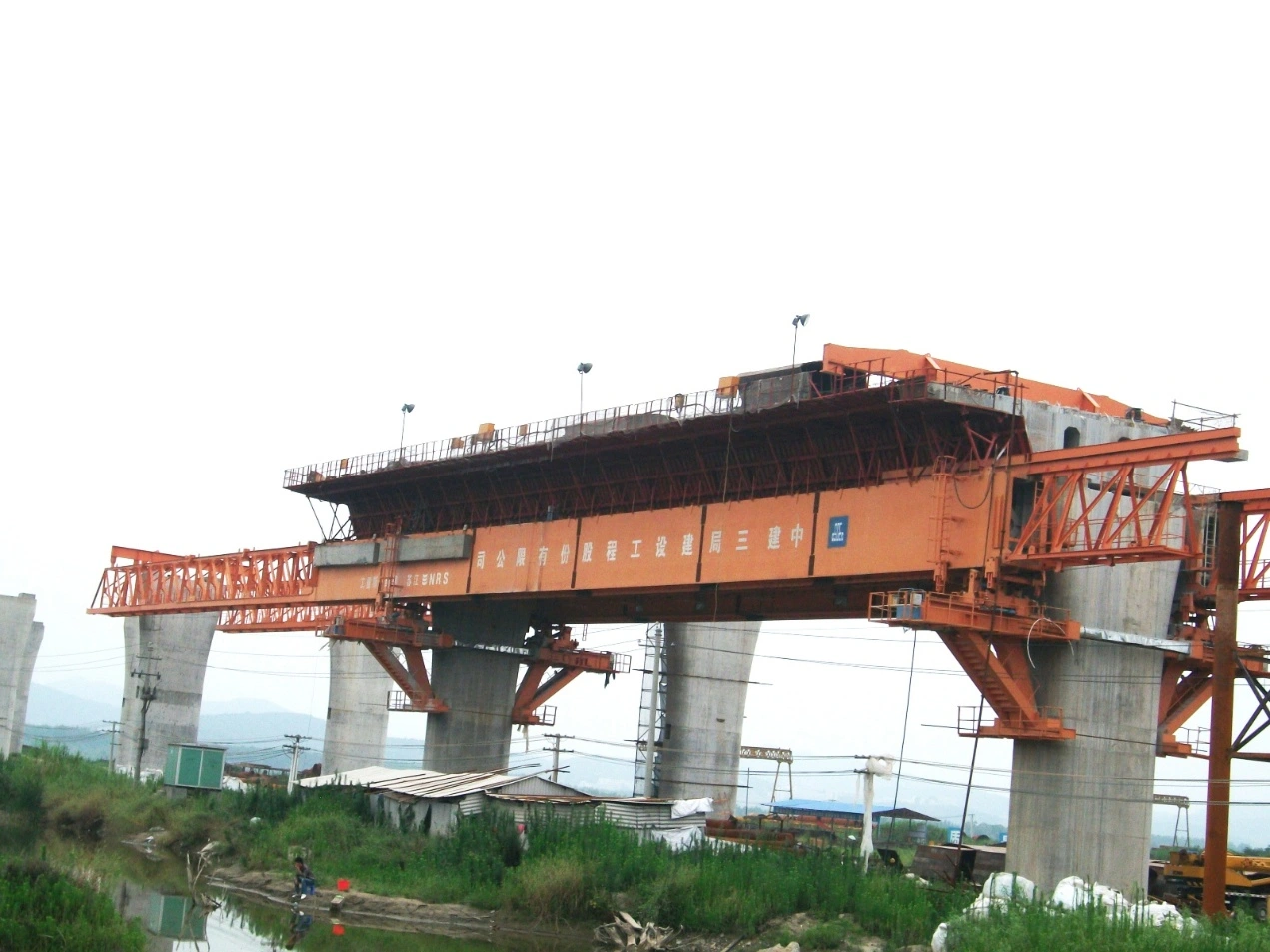
The movable scaffolding system (MSS), also known as a “bridge factory on wheels”, offers a more efficient approach by supporting itself on bridge piers and moving forward after each casting cycle without ground-based support.
For contractors and project owners, the key question is when the movable scaffolding system provides greater value than conventional methods. This article explores how the movable scaffolding system works, its applications, and its advantages in modern bridge construction.
Understanding the Movable Scaffolding System: How Does It Work?
Before comparing construction methods, it is important to understand how a movable scaffolding system works and why it is widely used in modern bridge projects.
Core Components and Design
A movable scaffolding system consists of a steel support structure spanning between bridge piers, with formwork either suspended or supported from the main frame. Its key components include:
- Main steel structure — the primary load-bearing framework supporting the construction load
- Formwork — the adjustable mold used to shape the concrete deck
- Launching mechanism — hydraulic systems that move the equipment to the next span
- Support brackets — temporary supports that transfer loads to the piers
The inner formwork can be collapsed and relocated through a rail system, while the outer formwork opens during launching to pass around bridge piers. After repositioning, the formwork is adjusted to the required alignment before reinforcement work begins.
Two Main Types of Movable Scaffolding Systems
Movable scaffolding systems are mainly divided into two types based on their structural arrangement and site conditions.
Overhead MSS — The main structure is positioned above the bridge deck, with formwork suspended underneath. This configuration is suitable for projects where access below the bridge is limited, such as construction over rivers, railways, or deep valleys.
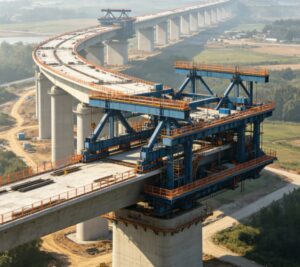
Underslung MSS — The main structure is installed below the deck, with formwork supported from the lower frame. It is commonly used for bridges with high piers or locations where ground-level crane access is restricted.
Both configurations provide similar load capacity and cost performance when designed for the same span requirements. The final selection depends mainly on bridge geometry, site accessibility, and construction conditions.
The Construction Cycle
The efficiency of a movable scaffolding system comes from its repeatable construction process:
- Positioning — The MSS moves forward from the completed span and is secured on the next pier supports.
- Formwork and reinforcement — The formwork is adjusted, and reinforcement is installed on the working platform.
- Concrete pouring and curing — The bridge span is cast and cured while fully supported by the system.
- Post-tensioning — Steel tendons are tensioned to provide the required structural strength.
- Launching forward — The MSS is lowered and moved to the next span to repeat the cycle.
With proper project management, a movable scaffolding system can typically complete a 40–50 meter span within 7–10 days. This predictable cycle helps contractors improve scheduling accuracy and reduce construction delays.
Movable Scaffolding System vs. Conventional Methods: A Detailed Comparison
To make an informed decision, project teams need a clear understanding of how the movable scaffolding system stacks up against conventional construction methods across key performance dimensions.
| Aspect | Movable Scaffolding System | Conventional Methods (Ground-Based Scaffolding/Falsework) |
|---|---|---|
| Span cycle time | 7–10 days per 40–50m span | 15+ days per span; up to 2× slower |
| Ground interference | Minimal — supported by piers | Extensive — requires full ground support |
| Material consumption | Optimized — favorable load conditions | Higher — full falsework for every span |
| Terrain adaptability | Excellent — works over water, high piers, difficult access | Limited — requires stable ground access |
| Labor requirements | Smaller, specialized crews | Larger crews for scaffolding erection |
| Equipment lifespan | 50+ years, reusable across projects | Single-use or limited reuse |
| Safety | Stable integrated platform | Scattered scaffolding with varied risk profiles |
| Environmental impact | Low — minimal ground disturbance | High — extensive site preparation |
| Cost efficiency | Most economical for 50+ spans | May be cheaper for short bridges or single spans |
Sources: Industry data and project case studies.
The movable scaffolding system offers clear advantages in speed, safety, and terrain adaptability. However, conventional methods may still be appropriate for shorter bridges or projects with very few spans, where the mobilization cost of an MSS cannot be justified.
Core Advantages of the Movable Scaffolding System
What makes a movable scaffolding system suitable for modern bridge construction? Its value comes from faster construction cycles, reduced site limitations, improved safety, and long-term equipment utilization.
Faster Span Construction
One of the key benefits of a movable scaffolding system is its ability to support repetitive span-by-span construction with a predictable working cycle. Unlike conventional methods that require scaffolding to be rebuilt for each section, MSS can be repositioned and reused throughout the project.
Real-world applications demonstrate this efficiency. At the River Lima bridge in Portugal, an overhead MSS completed 25 spans within 8 months. In another project in China, the construction time for a 40-meter span was reduced from 30 days using conventional methods to 15 days with MSS.
This shorter cycle helps contractors reduce labor requirements, improve project scheduling, and better manage risks caused by weather or site constraints.
Improved Cost Efficiency
Although the initial investment in a movable scaffolding system can be significant, its lifecycle value often becomes more competitive on large-scale bridge projects.
The main sources of cost savings include:
- Reduced ground-based scaffolding requirements — Eliminates repeated costs for purchasing, transporting, installing, and dismantling large falsework structures.
- Optimized material usage — The controlled loading conditions allow more efficient use of concrete, reinforcement, and prestressing materials.
- Lower labor demand — Requires fewer workers compared with traditional scaffolding-intensive construction methods.
- Shorter construction periods — Helps reduce project overhead and accelerate completion.
For long bridges with multiple repetitive spans, these advantages can significantly improve overall project economics.
Reduced Ground-Level Impact
A major advantage of this construction method is its ability to operate independently of ground conditions. Since the structure transfers loads directly to bridge piers, it reduces the need for extensive ground preparation.
A movable scaffolding system is particularly suitable for:
- Water crossings — Where riverbed scaffolding is difficult or environmentally restrictive.
- High pier bridges — Where crane access from ground level is limited.
- Environmentally sensitive areas — Where reducing disturbance to surrounding areas is required.
- Active transport routes — Where construction needs to minimize disruption to roads or railways below.
This reduced site footprint makes MSS a practical solution for projects with strict environmental or access requirements.
Enhanced Construction Safety
Safety is a critical factor in bridge construction, and MSS provides a more controlled working environment compared with scattered temporary structures.
The integrated platform helps:
- Reduce risks associated with working at height
- Provide safer access routes and walkways
- Limit worker exposure to fall hazards
- Minimize repeated scaffolding installation and removal activities
By creating a stable working platform throughout the construction cycle, MSS can help contractors improve site safety management and reduce downtime.
Long-Term Reusability and Sustainability
A movable scaffolding system is designed for repeated use across multiple bridge projects. With proper maintenance, MSS equipment can serve for decades, improving its lifecycle value and reducing the need for new equipment production.
Long-term benefits include:
- Lower demand for manufacturing new construction equipment
- Reduced environmental impact per project
- Better resource utilization compared with single-use alternatives
The Rail Baltica Neris bridge project is one example of long-term equipment reuse. The MSS used for the project was originally manufactured in 2005 for a viaduct in Portugal and has since supported multiple bridge projects across Europe.
Where Does the Movable Scaffolding System Deliver the Greatest Value?
Not every bridge project is a good fit for a movable scaffolding system. Understanding the ideal applications helps project teams make the right choice.
Long, Multi-Span Viaducts
The movable scaffolding system is most effective when there are many repetitive spans to construct. The system’s core advantage is its repetitive cycle, making it perfect for bridges and viaducts with many similar spans. MSS becomes most economical when the number of spans exceeds approximately 50. For shorter bridges with only a few spans, the mobilization and setup costs of an MSS may not be justified.
Projects in Difficult Terrain
The movable scaffolding system is the ideal solution for building bridges over deep valleys, wide rivers, or other areas where building scaffolding from the ground would be impractical or prohibitively expensive. The system’s ability to operate independently of ground conditions makes it uniquely suited to challenging sites.
Bridges with High Piers
When piers are very high, conventional methods become extremely difficult and expensive. Mobile cranes positioned at ground level may not have sufficient reach, and erecting scaffolding at such heights is dangerous and costly. The movable scaffolding system, supported by the piers themselves, eliminates these challenges.
Projects with Tight Deadlines
When the schedule is the primary constraint, the movable scaffolding system is hard to beat. The predictable 7–10 day cycle for each 40–50 meter span allows for accurate scheduling and rapid project completion. This is particularly valuable for infrastructure projects with fixed opening dates or penalty clauses for delays.
Environmentally Sensitive Projects
In areas where environmental impact must be minimized—such as Natura 2000 sites, waterways, or protected landscapes—the movable scaffolding system offers a low-impact solution. The minimal ground disturbance and reduced site footprint make MSS the preferred choice for sustainable infrastructure development.
Key Factors to Consider When Choosing a Movable Scaffolding System
Selecting the right movable scaffolding system for a project requires careful evaluation of several factors.
Span Length and Deck Geometry
Movable scaffolding systems are typically designed for spans in the range of 40–60 meters, though custom systems can accommodate spans from 20 meters up to 70 meters or more. The system must be designed to match the specific deck geometry, including width, crossfall, and longitudinal slope.
The underslung movable scaffolding system can be easily adapted to different deck sections and span lengths, as well as variable curvature radius in both vertical and horizontal directions.
Number of Spans
As noted earlier, MSS becomes most economical when the number of spans exceeds approximately 50. For projects with fewer spans, the mobilization and demobilization costs may outweigh the per-span efficiency gains. Project teams should conduct a cost-benefit analysis comparing MSS to conventional methods based on the specific project scale.
Site Access and Logistics
The choice between overhead and underslung movable scaffolding systems depends heavily on site access conditions:
-
Overhead MSS is preferred when access under the bridge is difficult—over rivers, railways, or congested traffic areas—because it can be assembled and dismantled behind the abutments.
-
Underslung MSS is typically assembled between the abutment and the first pier and is suitable when there is sufficient space beneath the structure.
Self-Launching Capability
One of the most significant innovations in movable scaffolding systems is the self-launching version (SL-MSS). This system is able to transfer forward and mount the pier support brackets without any need for external lifting equipment or cranes.
The self-launching movable scaffolding system is particularly valuable for:
-
Bridges over water, where positioning crane barges is difficult and expensive
-
High piers, where ground-level crane access is limited
-
Projects where crane availability is constrained, or costs are prohibitive
The SL-MSS has been successfully used in several major bridge projects worldwide and is widely sought after due to its reasonable cost and operational efficiency.
Quality and Safety Standards
When procuring a movable scaffolding system, ensure that the equipment meets recognized design and fabrication standards. The steel structure is typically designed under Eurocode for structural safety and EN 1090 for quality control of steel fabrication. Systems should be modelled in 3D or detailed 2D drawings, with precise weights supplied for all components to plan lifting and assembly operations safely.
Conclusion
The movable scaffolding system provides a more efficient and controlled approach to modern bridge construction by reducing ground interference, shortening construction cycles, and improving resource utilization.
For long multi-span viaducts, waterways, high piers, and other complex projects, MSS offers a practical alternative to conventional methods. The choice between overhead, underslung, standard, or self-launching configurations depends on specific project requirements, including bridge design, site conditions, and construction goals.
With proven performance in global infrastructure projects, the movable scaffolding system continues to support safer and more efficient bridge construction. Contact our team to discuss your project requirements and find the right MSS solution for your next bridge project.