




Introduction
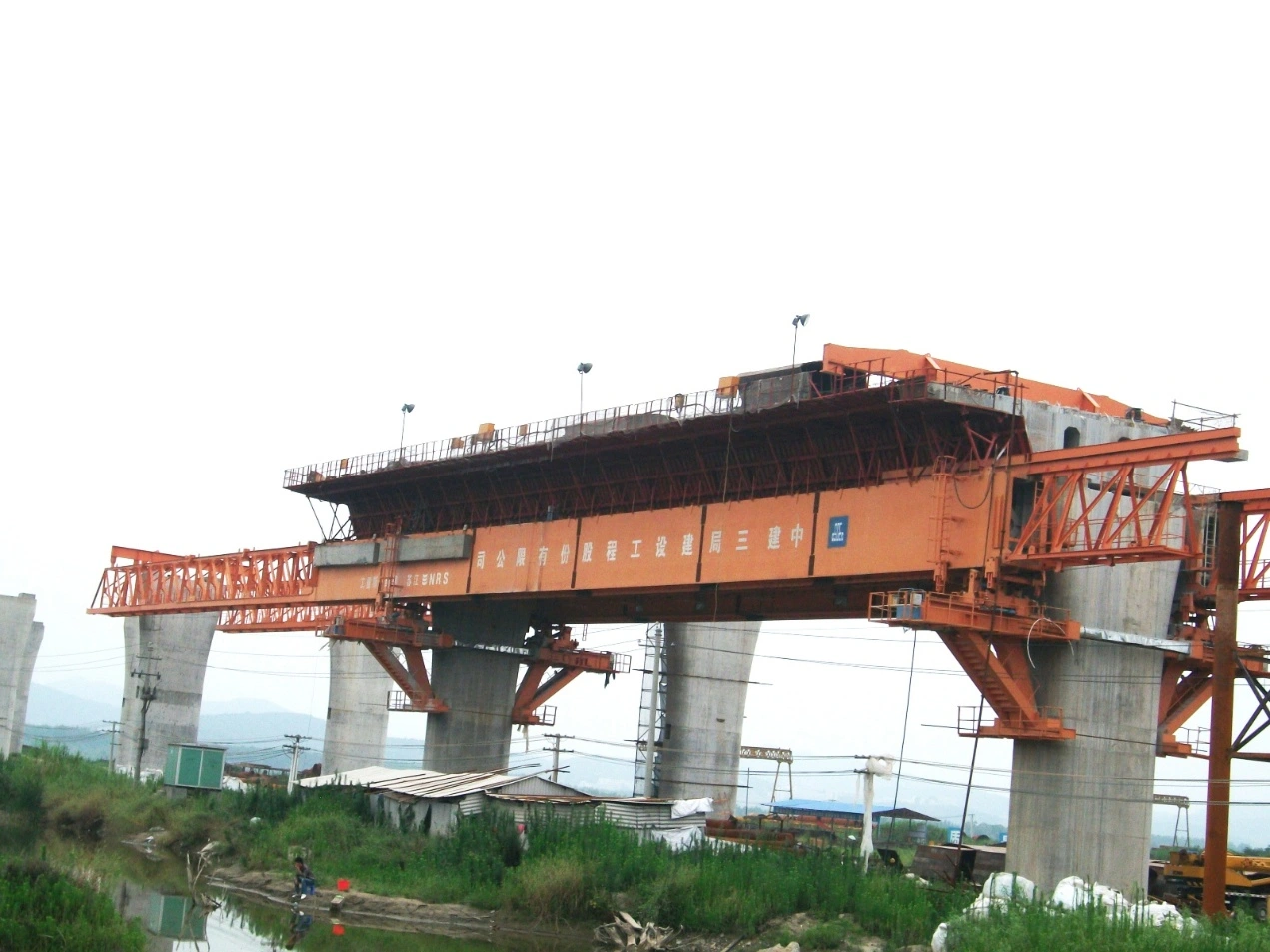
Choosing the right equipment is essential for efficient and safe bridge construction. A launching gantry is a specialized machine designed to lift, transport, and install precast bridge segments without relying on ground-based cranes, making it ideal for large-scale bridge projects with limited access.
Since each launching gantry is customized based on span length, segment weight, and project conditions, contractors need to carefully evaluate their requirements before selection.
What Exactly Is a Launching Gantry and How Does It Work?
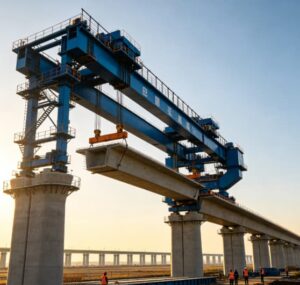
A launching gantry is a specialized bridge construction machine used to lift, transport, and install precast concrete segments or girders during bridge erection. Unlike traditional ground-based cranes, it operates on bridge piers, allowing construction in areas with limited ground access.
The system typically consists of twin main girders, lifting trolleys, and hydraulic launching mechanisms. It can move forward from one span to the next without complete dismantling, making it highly efficient for long viaducts and repetitive bridge projects.
Launching gantries are commonly used for span-by-span and balanced cantilever erection methods, providing precise segment placement while improving construction speed, safety, and overall project efficiency.
How do different types of launching gantry compare?
Not all launching gantries are built the same way. Understanding the different configurations is essential for any procurement decision.
| Type | Configuration | Best For | Key Advantage | Key Limitation |
|---|---|---|---|---|
| Overhead Launching Gantry | Girders above deck level | Heavy concrete box-girder bridges, high-speed rail | Excellent stability, handles segments over 150 tons | Requires higher clearance |
| Underslung Gantry | Girders below deck level | Curved or variable-width decks, low overhead clearance | Works where overhead space is limited | More complex setup |
| Full-Span Launching Gantry | Spans full width between piers | Long viaducts with repetitive spans | High productivity—one complete span per day | Less flexible for varying spans |
| Single-Girder Gantry | One main beam | Smaller bridge jobs, lighter beams | Simpler, more budget-friendly | Lower capacity |
| Double-Girder Gantry | Two parallel beams | Large highway and railway bridges | Heavier loads, longer spans | More setup required |
This comparison shows that the choice of launching gantry depends heavily on project-specific factors. A full-span overhead gantry might be perfect for a high-speed railway viaduct but completely wrong for a light rail project with tight curves.
What Are the Most Critical Selection Factors for a Launching Gantry?
Selecting the right launching gantry requires careful consideration of project requirements, including lifting capacity, bridge structure, site conditions, and construction schedule. The following factors are essential for contractors and project engineers during the procurement process.
-
Segment Weight and Dimensions
The launching gantry’s lifting capacity must match the maximum weight of bridge segments, including lifting beams and related equipment. Choosing a system with insufficient capacity can create safety risks, while excessive capacity may increase unnecessary costs.
For typical highway bridge projects, precast concrete segments often range from 50 to 200 tons, while large-scale railway projects may require systems capable of handling much heavier segments.
-
Span Length and Bridge Alignment
The main girder length of a launching gantry is generally designed according to the bridge span, with the twin girders typically extending around 2.3 times the distance between piers. This ensures stable support during segment installation and forward launching.
Bridge alignment is another key consideration. While standard gantries are suitable for straight bridges, projects with tight horizontal curves may require a hinged launching gantry. Advanced hinged systems can adapt to smaller curve radii, making them suitable for complex projects such as urban rail transit and curved viaducts.
-
Site Access and Construction Conditions
Limited ground access is one of the main reasons contractors choose a launching gantry instead of traditional cranes. Since the equipment operates from bridge piers, it is particularly suitable for projects over water, across valleys, or in congested urban areas.
Before installation, contractors should also evaluate transportation routes, assembly space, and whether additional lifting equipment is required for initial setup.
-
Construction Schedule and Production Requirements
Project timelines directly influence the launching gantry selection. High-capacity systems with efficient lifting and launching cycles can significantly improve construction speed, especially for long viaducts with repetitive spans.
For large-scale projects with many spans, investing in a more automated and productive system can reduce labor requirements and shorten completion time. Smaller projects may benefit from simpler configurations with lower initial costs.
-
Vertical and Horizontal Curvature Capability
Modern bridge projects often involve complex geometries, requiring launching gantries to handle variable slopes, curved alignments, and different deck configurations.
For bridges with tight horizontal curves, a hinged launching gantry provides greater flexibility by allowing the structure to adapt during segment erection and launching operations. These systems are commonly used in metro, railway, and other infrastructure projects where conventional gantries cannot meet alignment requirements.
What is the total cost picture for a launching gantry?
The purchase price of a launching gantry is only part of the equation. Total cost of ownership includes several factors that procurement professionals must consider.
Initial equipment cost
Launching gantries are custom-fabricated according to design requirements to overcome various site restrictions. This means pricing varies significantly based on capacity, configuration, and complexity. A basic highway gantry costs considerably less than a high-speed rail system with hinged articulation and 900-ton capacity.
Transportation and logistics
Getting a launching gantry to the site is not trivial. These are massive structures. Transportation costs depend on the distance from the manufacturing facility, the accessibility of the site, and whether the gantry can be shipped in manageable sections or requires specialized transport.
Assembly and erection
On-site assembly requires crane support, skilled labor, and time. Some gantries are designed for rapid assembly; others take weeks to erect. This cost is often overlooked in initial budget estimates.
Operational costs
Once operational, a launching gantry consumes fuel or electricity. Hydraulic systems require maintenance. Trolleys and winches experience wear. Spare parts must be stocked. These ongoing costs add up over the life of the project.
Productivity and schedule impact
This is where the right launching gantry pays for itself. A machine that places one span per day versus one every two days can shave months off a project schedule. In bridge construction, time savings translate directly to cost savings—fewer labor hours, lower financing costs, and earlier project completion.
A bridge launching gantry enables efficient transport and precise placement of bridge girders, greatly shortening construction time, reducing labor costs, and improving safety. It has become a key device to achieve faster, cheaper, and higher-quality bridge construction.
Resale value
Some launching gantries can be reused on multiple projects. A well-maintained machine with standard specifications may have significant resale value. Highly customized gantries, on the other hand, may have limited secondary market appeal.
How does a launching gantry compare to other bridge construction methods?
Understanding where a launching gantry fits in the broader construction equipment landscape helps justify the investment.
| Method | Equipment | Best Application | Key Advantage | Key Limitation |
|---|---|---|---|---|
| Launching Gantry | Self-launching truss system | Precast segmental bridges, long viaducts | No ground access needed, high productivity | High initial cost, custom-engineered |
| Ground-Based Crane | Mobile or crawler crane | Short spans, good ground access | Lower cost, readily available | Limited by reach and ground conditions |
| Movable Scaffolding System | MSS formwork | Cast-in-place segmental bridges | No precast yard needed | Slower than precast methods |
| Trestle Method | Temporary support structure | Limited-access sites | Lower equipment cost | Time-consuming to erect and dismantle |
The launching gantry method offers distinct advantages for projects with limited ground access, repetitive spans, and tight schedules. In areas where ground access is limited—over water, through wetlands, or across busy highways—the overhead launching gantry may offer the only practical and economical solution.
What special features should you look for in a launching gantry?
Beyond the basic specifications, certain features can make a significant difference in project execution.
Hinge articulation for curved bridges
For projects with tight horizontal curves, hinged launching gantries are a game-changer. The hinge concept allows the gantry to articulate and handle segment erection and launching operations on curves that conventional straight gantries cannot manage.
As many as six hinges, each regulated by hydraulic cylinders, have been used in a single launching gantry. A specially designed gantry crane travels smoothly through the kinked hinges during the lifting and placing of segments. The hinged launching gantry offers significant advantages over conventional straight gantries in terms of erection speed and cost of construction.
Glue-as-you-go capability
The “glue-as-you-go” concept for wet-joint segmental bridges reduces double handling of segments. Instead of staging segments twice, they are erected and glued in a single pass. This speeds up construction and reduces labor requirements.
Turnaround concept
The “turnaround” concept reduces stacking of segments within a span. This is particularly valuable on constrained sites where space for segment storage is limited.
Fail-proof hydraulic system
A reliable hydraulic launching system is essential for safety and productivity. Look for systems with redundancy and fail-safe features that prevent uncontrolled movement.
Self-launching capability
The gantry should be able to transport and support itself using its own crane. Self-launching capability eliminates the need for external lifting equipment during span-to-span moves, saving time and reducing logistics complexity.
What should you look for in a launching gantry supplier?
The equipment is only as good as the company that designs, manufactures, and supports it. Here is what to evaluate when selecting a launching gantry supplier.
Engineering and design capability
Launching gantries are custom-engineered for each project. The supplier must have the engineering expertise to design a machine that meets your specific requirements—span length, segment weight, alignment geometry, and site conditions.
Look for suppliers who use finite element analysis (FEA) to optimize strength-to-weight ratios and ensure structural integrity throughout the machine’s service life.
Manufacturing quality and standards
Ask about manufacturing certifications. ISO 9001 certification indicates quality management systems are in place. Welding procedures should follow recognized standards like AWS D1.1. Every structural component should undergo rigorous inspection before assembly.
Testing and commissioning
Reputable suppliers conduct full-load trials, structural inspection, and functional verification of all safety systems before shipment. Request documentation including design calculations, load test certificates, and maintenance manuals.
Project experience
Experience matters. Look for suppliers with a track record in projects similar to yours—same bridge type, same span range, same alignment challenges. A supplier who has successfully delivered gantries for metro projects with tight curves will understand your needs better than one who only builds straight-highway gantries.
After-sales support
Launching gantries are complex machines that require maintenance and occasional repairs. Does the supplier offer on-site commissioning assistance? Do they have responsive after-sales service? Can they supply spare parts quickly?
References and reputation
Ask for references from previous clients. Contact them. Ask about the supplier’s responsiveness, the equipment’s reliability, and whether the project was completed on schedule and within budget.
Making the right choice for your bridge project
Choosing a launching gantry is not a decision to be made lightly. The wrong choice can delay your project, inflate your costs, and create safety risks. The right choice can accelerate construction, improve quality, and reduce total project cost.
Here is a quick checklist for your procurement process:
-
Define your project parameters. Span length, segment weight, bridge alignment, site access conditions, and construction schedule.
-
Match requirements to gantry type. Overhead or underslung? Single-girder or double-girder? Full-span or segmental?
-
Evaluate special feature needs. Do you need hinge articulation for curves? Glue-as-you-go capability? Turnaround capability?
-
Calculate the total cost of ownership. Include purchase price, transport, assembly, operation, maintenance, and productivity impacts.
-
Qualify suppliers thoroughly. Engineering capability, manufacturing quality, testing procedures, project experience, and after-sales support.
-
Request and review documentation. Design calculations, load test certificates, safety system verification, and maintenance manuals.
The launching gantry you choose will be the backbone of your bridge construction project. Get it right, and the project flows smoothly. Get it wrong, and you will be explaining delays and cost overruns to stakeholders who have little patience for excuses.
Ready to select the right launching gantry for your next bridge project?
The right equipment partner makes all the difference. We specialize in custom-engineered launching gantries for highway, railway, and metro bridge projects—including hinged systems for tight curves and high-capacity solutions for heavy segments. Our team provides full engineering support, on-site commissioning, and responsive after-sales service. Contact us today to discuss your project specifications and receive a tailored equipment recommendation. Let us help you build smarter, faster, and safer.