



Introduction
When planning a new bulk material handling facility or upgrading an existing stockyard, one question stands out: which stacker reclaimer design best fits your layout?
The right choice can significantly improve throughput and reduce operating costs, while the wrong one often leads to bottlenecks, wasted space, and frequent downtime. Stacker reclaimers are essential machines that stack and reclaim bulk materials such as coal, iron ore, limestone, gypsum, and phosphates. They are widely used in mining, power plants, cement production, ports, and chemical facilities.
Every stockyard is unique. Your site layout, material characteristics, required throughput, and available space all determine the most suitable stacker reclaimer design. Let’s examine the main options in detail.
What is a stacker reclaimer?
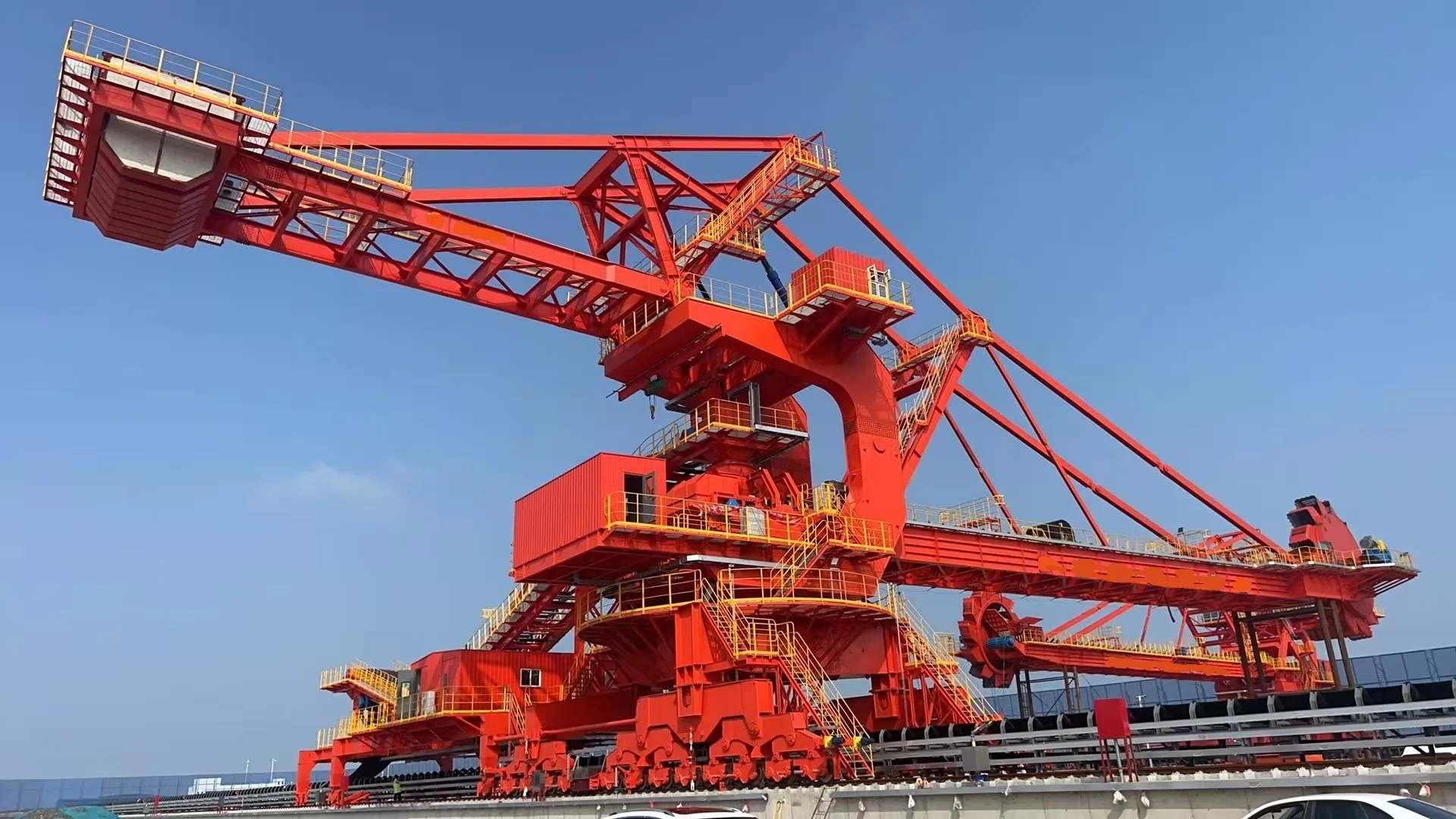
Before we compare designs, let us clarify what we are talking about. A stacker reclaimer is a large, versatile machine used in bulk material handling to efficiently stack and reclaim materials such as coal, iron ore, and limestone in stockyards. It combines two functions into a single unit:
-
Stacking – piling bulk materials onto a stockpile in an organized manner.
-
Reclaiming – recovering bulk materials from the stockpile for processing or shipment.
Combined stacker reclaimers are versatile machines that can both stack and reclaim materials. This versatility makes them highly efficient in terms of space utilization, as they can perform two essential functions in one machine, reducing the need for separate stacking and reclaiming equipment. The operational flexibility of a single stacker reclaimer also reduces capital expenditure and simplifies maintenance logistics.
The key question is not whether you need a stacker reclaimer—you almost certainly do. The question is which type fits your specific stockyard layout and operational requirements.
The two fundamental stockyard layouts
Stockyards come in two primary configurations: longitudinal and circular. Your layout choice is the single most important factor in selecting a stacker reclaimer design.
Longitudinal stockyards
Longitudinal stockyards are the most common configuration for large-scale outdoor operations. Material is stacked in long, parallel piles, and the stacker reclaimer travels on rails alongside these piles. These layouts are typically found at ports, power plants, and large mining operations where space is abundant and high throughput is the priority.
The capacity of a longitudinal stockyard depends on the number of reclaimers, not on the number of stackers. This means you can scale your operation by adding more reclaimers without necessarily adding more stackers—a useful flexibility for growing operations. Longitudinal yards also allow for multiple stockpiles of different materials, which is essential for operations that handle more than one product.
Circular stockyards
Circular stockyards, by contrast, are compact and often housed inside a dome for environmental protection. The stacker reclaimer is positioned in the center, pivoting to build a ring-shaped stockpile. Material is fed from a conveyor bridge located above the stockyard directly into the stacker’s axis of rotation.
Circular designs are ideal where space is constrained or where environmental regulations require covered storage. The continuous process of simultaneous loading and unloading is possible without restrictions—a significant advantage over longitudinal layouts. Circular stockyards also offer better blending capabilities because the material is deposited in layers around the ring.
Stacker types: matching the stacker to your yard
Stackers themselves come in several varieties. Understanding these options is essential because the stacker component of your stacker reclaimer must match your stacking strategy.
Luffing stackers
Luffing stackers can raise and lower their boom to control the drop height of material onto the pile. This is important for minimizing material degradation and dust. As the pile grows, the boom is luffed up progressively, reducing the distance the material falls. Lower drop heights also help preserve the particle size distribution of the material.
Luffing and slewing stackers
These stackers add rotation capability to luffing. Full slewing allows the stacker to stack on two parallel stockpiles and to use various stacking methods to mix ore better on the stockpile. The slewing radius should cover both the length and width of the stockyard to minimize frequent machine repositioning. Larger slewing angles offer greater operational flexibility but increase structural complexity and cost.
Radial stackers
Radial stackers are positioned in a fixed place and stockpile material in a circular storage system by slewing the boom up to 360 degrees. These are the stackers used in circular stockyard configurations. They are simpler in design than traveling stackers and require less maintenance.
Stacking methods
The way you stack material matters as much as the machine itself. Common stacking methods include:
-
Chevron stacking – material is deposited in layers at an angle, creating a pile with a triangular cross-section. This method is excellent for blending because each layer contains material from different parts of the stockpile.
-
Cone stacking – material is dropped from a fixed point, creating a conical pile. This is the simplest method but offers limited blending.
-
Strata stacking – material is deposited in horizontal layers, creating a stratified pile that can be reclaimed selectively.
Chevron stacking, where material is deposited in layers at an angle, is particularly common for blending applications. The stacking method you choose affects how easily the reclaimer can later recover the material and how well the material is blended.
Reclaimer types: the other half of the equation
If the stacker builds the pile, the reclaimer takes it down. Your choice of reclaimer type is equally critical to your stacker reclaimer selection.
Bucket wheel reclaimers
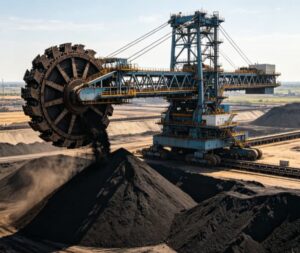
Bucket wheel reclaimers use buckets mounted on a revolving wheel to scoop up material. The boom bucket reclaimer is the most flexible machine for stockpile operation and offers the highest continuous reclaim rates—more than 10,000 tonnes per hour is possible. The bucket wheel can be placed on a boom or a bridge.
These machines are ideal for high-capacity operations where continuous, reliable reclaiming is the priority. They handle a wide range of materials and can be configured for both longitudinal and circular stockyards. The bucket wheel design allows for selective reclaiming, meaning you can target specific layers of the stockpile if needed.
Scraper reclaimers
Scraper reclaimers use a chain with gathering scrapers to reclaim material. They come in several configurations:
Bridge scraper reclaimers are used to homogenize or blend bulk materials. They are equipped with heavy-duty scraper chains and can process parallel beds. The bridge-type scraper reclaimer can only reclaim bulk materials from the end of the stockpile; it cannot cross the stockpile. However, bridge reclaimers are equipped with a harrow rake that mixes the cross-section of the pile, delivering high blending and homogenization效果. They are suitable for chevron stacking methods.
Portal scraper reclaimers, by contrast, can reclaim multiple different stockpiles from any section of the stockpile or in any order. Portal-type scraper reclaimers have much higher reclaiming production capacity than bridge-type scraper reclaimers. They are mainly used in situations where blending requirements are not extremely high. The portal design allows the scraper chain to traverse the full width of the stockpile.
Drum-type reclaimers
Drum-type reclaimers use a rotating drum fitted with a series of buckets along its length. The drum spans the stockpile and is mounted on rails on both sides. These are less common but offer unique advantages for specific applications, particularly in confined spaces.
Combined stacker reclaimers: the best of both worlds
The stacker reclaimer combines stacking and reclaiming functions into a single machine. There are two main types:
Boom-type stacker reclaimers (also known as bucket wheel combis) are similar to bucket wheel reclaimers, but the boom conveyor can work in two directions—stacking and reclaiming. When in stacking mode, the boom conveyor feeds material onto the pile. When in reclaiming mode, the bucket wheel scoops material, and the boom conveyor carries it away.
Radial stacker reclaimers combine a radial stacker with a scraper reclaimer. These are commonly used in circular blending systems.
The advantage of a combined stacker reclaimer is obvious: one machine does the work of two, saving space and capital investment. The trade-off is that a combined machine cannot stack and reclaim simultaneously—it must switch between modes. For operations where simultaneous stacking and reclaiming is required, separate machines may be necessary.
Key selection criteria: how to choose
Selecting the right stacker reclaimer design involves evaluating several critical factors:
Stockyard layout and available space
This is the starting point. Longitudinal layouts require traveling stacker reclaimers that move along rails. Circular layouts require center-pivot designs. If space is constrained, a circular may be your only option. If you have abundant land and need maximum capacity, longitudinal is often the better choice. Consider also the height of the stockpile—some designs are better suited for high piles.
Material type and characteristics
Different materials behave differently. Abrasive materials like iron ore require heavy-duty construction and wear-resistant components. High-moisture materials may require special handling to prevent sticking. The density, particle size, and flow characteristics of your material all influence the design of your stacker reclaimer. For example, materials with high fines content may generate excessive dust, requiring dust suppression systems.
Throughput requirements
How much material do you need to move per hour? Bucket wheel reclaimers can handle over 10,000 tonnes per hour. Scraper reclaimers typically have lower capacities but offer better blending. Match the machine’s capacity to your required throughput—oversizing wastes capital, undersizing creates bottlenecks.
Blending requirements
If you need to blend materials to achieve a consistent quality, bridge scraper reclaimers offer superior homogenization. If blending is not a priority, portal scraper reclaimers or bucket wheel reclaimers may suffice.
Environmental considerations
If dust control or environmental regulations require covered storage, circular stockyards with dome enclosures are often the solution. If your operation is outdoors in a remote area, longitudinal layouts may be more practical. Dust suppression systems—water sprays, fog cannons, or enclosure panels—are often integrated into modern stacker reclaimer designs.
Budget and lifecycle costs
The upfront cost of a stacker reclaimer is significant, but it is only part of the equation. Consider maintenance costs, energy consumption, and expected service life. Higher-quality machines may cost more initially but deliver lower total cost of ownership over decades of operation. Pay attention to the availability of spare parts and the manufacturer’s service network.
Automation and control
Modern stacker reclaimers are increasingly automated. Consider whether your operation requires:
-
Fully automated stacking and reclaiming cycles
-
Remote monitoring and diagnostics
-
Integration with your plant’s overall control system
-
Position tracking and inventory management
Automated systems minimize material waste and ensure a consistent feed to production lines, directly impacting operational cost-efficiency.
Comparison table: Stacker reclaimer types at a glance
| Design Type | Best For | Key Advantage | Key Limitation |
|---|---|---|---|
| Longitudinal boom-type | Large outdoor yards, high capacity | Highest reclaim rates, flexible | Requires more space |
| Circular radial type | Space-constrained, covered storage | Compact, simultaneous stacking/reclaiming | Lower total capacity |
| Bucket wheel reclaimer | High-throughput, continuous operation | Up to 10,000+ tph | Less effective for blending |
| Bridge scraper reclaimer | Blending and homogenization | Excellent mixing | End-only reclaim, lower capacity |
| Portal scraper reclaimer | Multiple stockpiles, flexible reclaim | Can reclaim from any section | Lower blending capability |
Stockyard capacity calculation
Understanding how capacity is calculated helps you size your stacker reclaimer correctly. For a longitudinal stockyard, total capacity is determined by the number of reclaimers. Each reclaimer has a specific reclaim rate (tonnes per hour). The total throughput is the sum of all reclaimers’ capacities, assuming they can operate independently.
For a circular stockyard, capacity is typically lower because the center-pivot design limits the length of the reclaimer arm. However, circular yards offer better blending and more consistent material quality.
A simplified formula for estimating required reclaimer capacity:
Required reclaim rate (tph) = Total daily throughput (tonnes) ÷ Operating hours per day
Add a buffer of 10-20% to account for maintenance downtimes and peak demand periods.
Operational efficiency and maintenance
A well-designed stacker reclaimer should be easy to maintain. Key maintenance considerations include:
-
Accessibility of critical components (motors, gearboxes, bearings)
-
Lubrication systems – centralized automatic lubrication reduces downtime
-
Wear parts – how often do bucket teeth, scraper chains, and liners need replacement?
-
Diagnostic systems – real-time monitoring of temperature, vibration, and alignment
Some manufacturers offer condition-based monitoring systems that alert operators before failures occur. This predictive approach to maintenance can significantly reduce unplanned downtime.
The role of automation in modern stacker reclaimers
Automation is transforming the way stacker reclaimers operate. Leading designs now offer fully automated operational modes, enabling continuous, unattended material stacking and reclaiming cycles. Automation reduces labor costs, improves safety by removing operators from hazardous areas, and ensures consistent operation.
Automated stacker reclaimers typically include:
-
Position control – precise tracking of the machine’s location relative to the stockpile
-
Stockpile modeling – 3D mapping of the pile’s shape and volume
-
Remote control – operation from a central control room
-
Fail-safe systems – automatic shut-down in case of overload or malfunction
Safety considerations
Safety is paramount when operating large, heavy equipment in dusty environments. Look for stacker reclaimers that include:
-
Emergency stop systems at multiple locations
-
Collision avoidance sensors
-
Dust suppression systems
-
Guardrails and walkways for maintenance access
-
Clear visual and audible warnings during operation
Real-world considerations
Here is something many buyers overlook: stacker reclaimers are almost always tailor-made. No standard types are available off the shelf. Every machine is adapted to the customer’s specific requirements. This means you have significant flexibility in design—but it also means you need to be very clear about your requirements from the start.
Another consideration: stacker selection should be managed with reclaimer selection to get the best performance of a stockpile system. These two components work together, and optimizing one without the other is a recipe for suboptimal performance.
Industry standards and certifications
When evaluating suppliers, ask about compliance with relevant standards:
-
ISO 5049 – Mobile equipment for continuous handling of bulk materials
-
CEMA – Conveyor Equipment Manufacturers Association standards
-
ASME – American Society of Mechanical Engineers safety codes
-
Local regulations – environmental and safety requirements in your jurisdiction
Conclusion
The best stacker reclaimer design depends entirely on your specific operation.
A longitudinal boom-type bucket wheel stacker reclaimer suits large outdoor stockyards with high throughput and ample space. A circular radial design works better for limited space or covered storage. For precise blending and homogenization, bridge scraper reclaimers perform well, while portal scraper reclaimers offer greater flexibility when reclaiming from multiple piles.
There is no universal “best” design — only the one that matches your layout, material type, throughput targets, and blending needs. The right choice will deliver reliable performance for decades; the wrong one will create ongoing inefficiencies.
If you’re planning a new facility or upgrading an existing stockyard, contact our team. We’ll review your site conditions and requirements to recommend the most suitable stacker reclaimer solution.