




Introduction
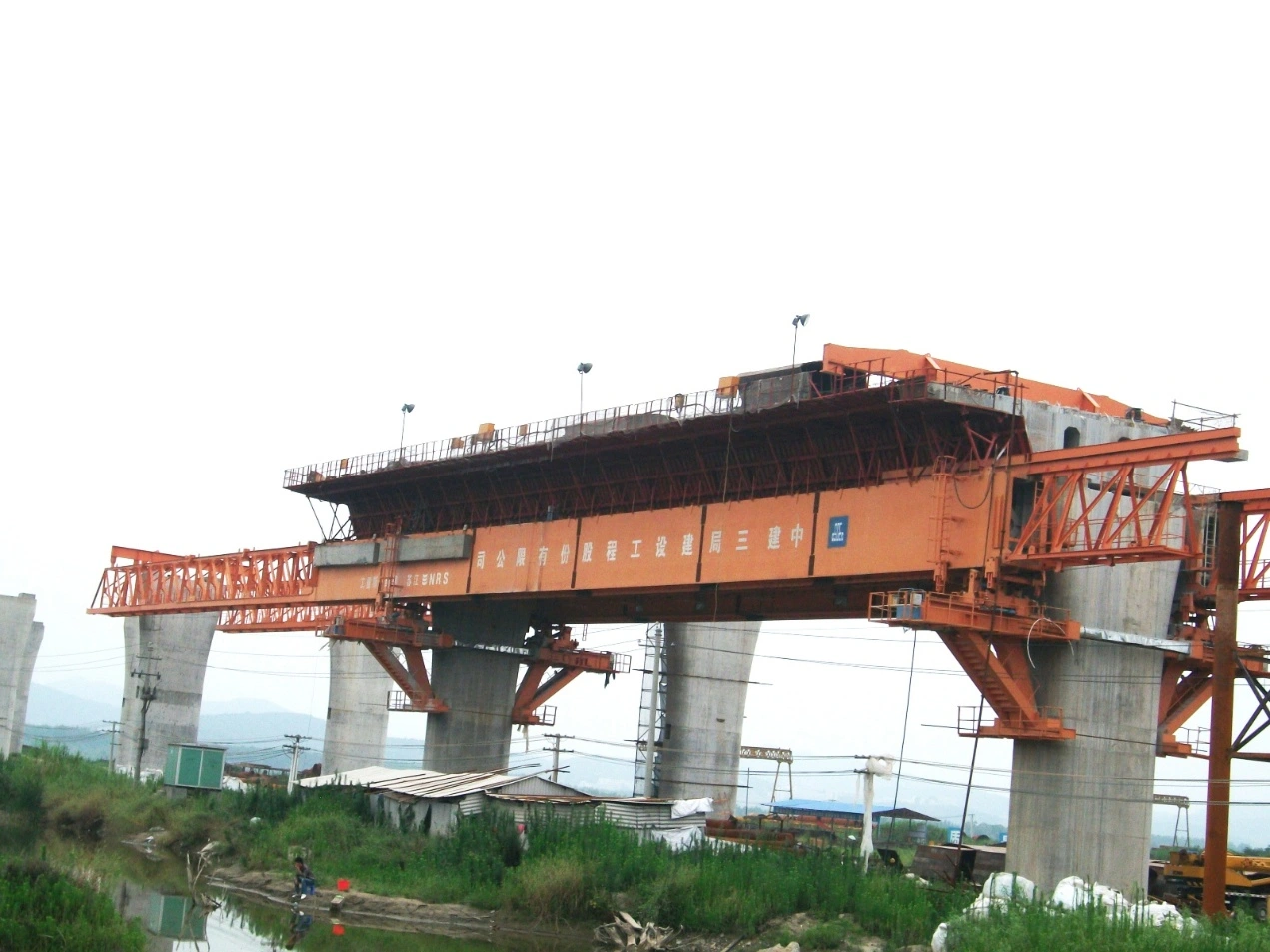
Bridge construction is high-risk by nature. When precast concrete segments weighing hundreds of tons are lifted dozens of meters above ground, even a minor failure can have serious consequences. The launching gantry—the massive steel structure spanning between piers to assemble bridge segments—is at the core of modern segmental bridge construction.
But what happens when a launching gantry fails? Past incidents provide a sobering reminder. In 2004, a launching gantry collapse in Ohio, resulting in the loss of four ironworkers. More recently, a 2026 accident in Thailand led to dozens of fatalities when a launching gantry crane struck a passenger train.
These events highlight a clear reality: safety in a launching gantry is not optional—it is engineered into the system. So what safety features must a launching gantry include to prevent such failures? This article breaks down the critical systems that separate reliable operations from catastrophic risk.
How Does Structural Redundancy Prevent Catastrophic Gantry Failure?
The High-Stakes Reality of Gantry Design
Launching gantries are complex, delicate structures that resist enormous loads during bridge erection and overtake long spans during self-launching. They’re designed for high stress levels under varying load and support conditions, which inherently makes them prone to instability. The consequences of failure are severe, which is why these structures fall into reliability class 3 under European standards, meaning the consequences of failure are likely to be high. Thus, every launching gantry must incorporate robust redundancy measures to ensure that no single point of failure can trigger a collapse.
Anchoring Systems: The First Line of Defense
One of the most critical structural safety features is the anchoring system. During launch sequences, the gantry must remain absolutely fixed in position. The OSHA investigation into the 2004 Maumee River Crossing collapse revealed that the manufacturer required sixteen anchoring bars for the rear legs alone—each pre-stressed to 600 kN (approximately 135,000 pounds of force) to resist longitudinal and transversal forces. When contractors deviate from these manufacturer guidelines, the results can be fatal.
Hinge Technology for Curve Bridges
Traditional straight gantries struggle with curved bridge alignments—a common challenge in urban metro and light rail projects. NRS developed an innovative “hinged” concept in the early 1990s that allows articulation of the launching gantry to handle segment erection and launching operations on curves. This hinge solution enables span erection on horizontal radii as small as 75 metres (with 40-metre spans)—something previously considered impossible without additional external temporary supports.
As many as six hinges, each regulated by hydraulic cylinders, can be used in a single gantry. A specially designed gantry crane travels smoothly through these kinked hinges during lifting and placing operations. This hinge technology isn’t just about flexibility—it’s about safety on challenging alignments where conventional equipment would be unstable or require dangerous temporary support structures.
Independent Design Verification
Given the stakes, responsible manufacturers subject their launching gantry designs to independent checking. Design and operational failures detected through independent design check assignments have provided critical lessons that prevent future failures and assure adequate robustness. This independent verification adds an essential layer of safety accountability.

What Hydraulic and Control Systems Protect Against Operational Failures?
Fail-Proof Hydraulic Launching Systems
Hydraulic systems are the muscles of any launching gantry, controlling everything from lifting to hinge articulation to the entire launch sequence. NRS incorporates a fail-proof hydraulic launching system—a feature that has contributed to their reputation as one of the most recognised suppliers of launching gantries worldwide. But what makes a hydraulic system “fail-proof”?
The answer lies in multiple layers of protection:
-
Overflow valves in the hydraulic system that restrain abnormal high pressure in the circuit, preventing damage to hydraulic pumps and motors while preventing overload conditions
-
Counterbalance valves integrated into lifting towers that prevent uncontrolled load descent
-
Pressure transducers that provide real-time pressure monitoring
-
Stroke sensors that track cylinder position and prevent over-extension
These components work together like a nervous system—constantly sensing, monitoring, and responding to changing conditions.
Emergency Stop and Safety Brakes
Every launching gantry must be equipped with emergency stop devices that immediately halt all operations when activated. But emergency stops are only as good as the braking systems backing them up. Spring-applied safety brakes—which engage automatically when hydraulic pressure drops—provide a critical failsafe. These brakes are used in gantry, trolley, and hoisting applications across industrial settings, ensuring that loads remain secure even during power loss or system failure. These safety brakes are integral to any launching gantry, providing a mechanical backup that operates independently of electronic controls.
Boom and Luffing Safety Devices
The boom (or cantilever arm) of a launching gantry presents particular risks during extension and retraction. Dedicated boom luffing safety devices and boom telescopic safety devices prevent uncontrolled movement. These systems ensure that as the gantry extends forward to reach the next span, it does so in a controlled, predictable manner.
How Does Live Monitoring Enhance Launching Gantry Safety?
The Shift from Manual to Digital Monitoring
Traditionally, operators and engineers had to physically go onto the bridge deck and the launching gantry to gather data—a time-consuming process that increased accident risk and was prone to reading and reporting errors. The industry has shifted decisively toward smart monitoring solutions.
VSL and Bouygues Travaux Publics developed a smart solution combining sensors, data acquisition, and live data management to closely monitor launching gantries onsite. This technology provides instantaneous data for operating and troubleshooting equipment, plus automatic reports to monitor cycles and performance.
Sensor Arrays: The Digital Nervous System
Modern launching gantries incorporate numerous sensors:
| Sensor Type | Safety Function |
|---|---|
| Video cameras | Visual monitoring of operations and personnel |
| GPS | Precise positioning and alignment tracking |
| Load sensors | Real-time weight monitoring to prevent overload |
| Positioning sensors | Segment placement accuracy verification |
| Pressure sensors | Hydraulic system health monitoring |
| Proximity sensors | Collision avoidance and personnel protection |
| Anti-collision sensors | Preventing gantry-to-gantry or gantry-to-structure impacts |
Real-Time Data Accessibility
This data can be stored for long-term analysis and reported live via user-friendly digital interfaces. The technology improves safety, provides accurate and systematic data, and is accessible everywhere—enabling teams to collaborate closely on monitoring and improving productivity. Jean-Marie Laurens, Director of Civil Works Business Line at VSL, noted: “This new technology brings a huge number of benefits and will now be used on all our projects”. Live monitoring transforms the way a launching gantry is operated, shifting from reactive maintenance to proactive risk management.
Data for Continuous Improvement
Perhaps most importantly, data is retained for future analysis, assisting with continuous improvement of performance. This means that every project contributes to a growing body of knowledge that makes subsequent projects safer.
What Load and Overload Protection Systems Are Essential?
Overload Protection: Non-Negotiable Safety
Every launching gantry must be equipped with overload protection devices that prevent lifting beyond rated capacity. These systems typically include:
-
Weight overload protection that triggers alarms and stops lifting when loads approach capacity limits
-
Lifting height limit devices that prevent over-travel
-
Voltage lower protection that safeguards against power fluctuations
Load Testing Requirements
Industry standards mandate rigorous load testing before any gantry enters service. Gantry cranes should undergo load tests with weights that exceed the manufacturer’s given load capacity. Typical practice involves testing to 110% or 125% of rated capacity, depending on industry standards.
For example, Enerpac tests each gantry to 125% of capacity at full extension, with testing witnessed by qualified third-party organisations. Static load tests subject each individual gantry leg to 125% of its load capacity at all stages, followed by Factory Acceptance Testing covering all functional aspects. Load testing verifies that a launching gantry meets its rated capacity and reveals any hidden manufacturing defects before the equipment is put into live service.
Safety Factors in Design
Beyond testing, launching gantries are designed with inherent safety factors—multipliers applied to calculated load capacity to account for unforeseen forces, wear and tear, and manufacturing tolerances. Typical safety factors range from 1.5 to 2.5, depending on application criticality. This means a gantry rated for 500 tons may be designed to withstand 750 to 1,250 tons of force—a substantial margin that accounts for the unpredictable nature of construction environments.
How Do Anti-Collision and Personnel Protection Systems Work?
Collision Prevention Technologies
Construction sites are crowded, dynamic environments. Multiple gantries may operate in proximity; workers, vehicles, and equipment move constantly beneath and around the structure. Anti-collision systems have become essential safety features.
These systems typically employ:
-
Laser scanners (2D or 3D) that create safety zones around the gantry
-
Safety controllers that process sensor data and trigger responses
-
Audible and visual alarms that warn when safety zones are breached
-
Automatic stop controls that halt movement when obstacles are detected
When a laser sensor detects another crane or obstacle inside a pre-programmed safety zone, the crane stops moving automatically. Anti-collision sensors protect a launching gantry and nearby workers by creating a virtual safety bubble that cannot be breached without immediate intervention.
Worker Safety During Load Testing and Operations
Specific safety protocols protect personnel during critical operations:
-
Isolation of operating areas with warning barriers and clear signage to prevent unauthorised entry
-
Strict prohibition of personnel standing or working under suspended test loads
-
Clear communication systems between operators, riggers, and ground personnel
Travel Alarms and Warning Systems
Basic but essential safety devices include:
-
Audible travel alarms that warn when the gantry is moving
-
Warning lights that provide visual alerts
-
Bumpers that absorb impact at travel limits
These may seem simple, but they save lives by ensuring that everyone on site knows when heavy equipment is in motion.
How Does Environmental Adaptation Enhance Safety?
Wind and Weather Protection
Launching gantries operate in exposed conditions where wind, temperature extremes, and weather events pose significant risks. The structural design must account for horizontal loads—wind on the payload being a major contributor.
Key environmental safety features include:
-
Fixing connections capable of resisting emergency conditions such as strong winds and typhoons
-
Temperature-rated components designed for operating ranges from -10°C to +40°C
-
Relative humidity tolerance up to 90%
Vertical and Horizontal Adaptation
Modern launching gantries must adapt to challenging site conditions while maintaining safety:
-
Vertical climbing capability to accommodate tight vertical curvature and steep longitudinal falls
-
Lifting and adjustment systems that can lift and adjust whole spans in level and line (vertical and transverse adjustment)
-
Self-launching capability that allows the gantry to transport its own supports
Multi-Track and Bifurcation Adaptations
For complex projects involving parallel tracks or bifurcation spans, separate centre-beam designs accommodate the erection of separate parallel double and triple tracks. This adaptability isn’t just about efficiency—it’s about maintaining stability and safety in geometrically complex scenarios.
Comparison Table: Essential vs. Optional Safety Features
| Safety Feature Category | Essential | Why It’s Critical |
|---|---|---|
| Structural Anchoring | ✓ | Prevents longitudinal/transversal movement during launching; failure here was cited in fatal OSHA investigations |
| Overload Protection | ✓ | Prevents catastrophic structural failure from overloading; industry standard requires 110-125% testing |
| Emergency Stop System | ✓ | Immediate halt capability during emergencies; spring-applied brakes provide a failsafe |
| Hydraulic Pressure Relief | ✓ | Prevents over-pressurisation and component failure; protects pumps, motors, and cylinders |
| Anti-Collision Sensors | ✓ | Protects workers and equipment in congested sites; laser scanners create safety zones |
| Live Monitoring System | ✓ | Real-time data prevents errors and eliminates the need for dangerous manual inspections |
| Hinge Articulation | Optional* | Essential for curve bridges; prevents the need for dangerous temporary supports on tight radii |
| Weather-Resistant Design | ✓ | Protects against wind, temperature, and humidity extremes that could compromise stability |
| Load Testing (125%) | ✓ | Verifies structural integrity before service; third-party witnessing ensures accountability |
| Travel Alarms & Lights | ✓ | Alerts personnel to gantry movement; basic but proven life-saver |
*Hinge articulation is essential for projects with tight horizontal curves, optional for straight alignments.
What Industry Standards Govern Launching Gantry Safety?
International Standards
Several standards bodies provide frameworks for launching gantry safety:
-
EN 15011 (European Standard) specifies requirements for bridge and gantry cranes, covering significant hazards, hazardous situations, and events relevant when used as intended
-
ASME B30.2 (American Society of Mechanical Engineers) provides safety standards for overhead and gantry cranes
-
ISO/DIS 12480-5 establishes required practices for the safe use of bridge and gantry cranes through safe systems of work
-
AS 2550.3 (Australian Standard) provides requirements for the safe use of bridge, gantry, and portal cranes
OSHA Requirements
In the United States, OSHA regulates overhead and gantry crane safety under 29 CFR 1910.179. This regulation covers general requirements, design, inspection, maintenance, and operations. Key requirements include:
-
Equipment inspection schedules before each use and periodically throughout service life
-
Load weight limits that must not be exceeded
-
Operator training and certification requirements
The OSHA Safety and Health Information Bulletin SHIB 05-01-2006 specifically addresses overhead launching gantry crane safety, emphasising that all employers must comply with manufacturer guidelines, including proper anchoring during launching.
The Cost of Non-Compliance
The consequences of ignoring these standards are severe. As one analysis noted, regulated inspection and certification of launching gantries throughout assembly, initial launch, and construction—as well as operator certification—could have identified numerous instances of failure to follow manufacturer operational procedures. When these procedures aren’t followed, the results can be catastrophic.
Conclusion: Safety Is Not Optional—It’s Engineered
Safety in a launching gantry is not optional—it is engineered into every system layer. From structural redundancy and hydraulic fail-safes to monitoring and anti-collision systems, each feature is designed to protect both people and project outcomes.
When evaluating a launching gantry, factors such as anchoring design, hydraulic protection, monitoring systems, and testing standards are just as important as capacity and span. A proper assessment ensures the equipment can perform reliably under complex construction conditions.
Ultimately, the true value of a launching gantry lies in delivering safe and consistent performance throughout the entire bridge construction process. If you are planning a project or evaluating equipment options, consulting with an experienced manufacturer can help ensure the right configuration for your site conditions, safety requirements, and engineering standards in line with OSHA, ASME, EN, and ISO guidelines.